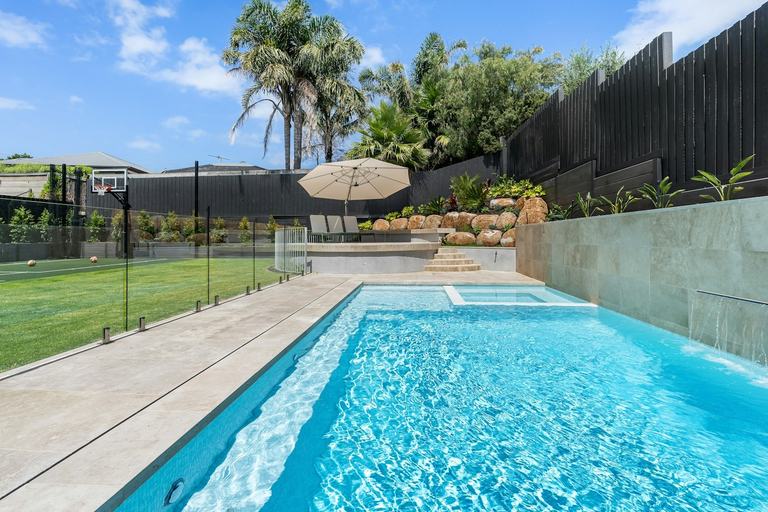
Pool Safety Inspections · Geelong

Pool Safety Inspection
Geelong & the Bellarine

You can book a pool safety inspection anywhere in Geelong and the Bellarine Peninsula with Local Pool Inspections, Ryan Gaw, VBA-registered Pool Safety Inspector (IN-PS 100055). The cost is a flat $250 all-inclusive — no hidden fees — with a same-day Form 23 compliance certificate where your pool or spa barrier passes, plus free re-inspections. Call 0402 860 499.

Flat fee
$250 all-inclusive · no hidden costs
Turnaround
Same-day Form 23 once your barrier meets compliance
Inspector
Ryan Gaw · VBA-registered · Licence IN-PS 100055
Rated 5.0★ · Google reviews

Registered Geelong Pool Safety Inspector

VBA-registered pool safety inspector covering Greater Geelong & the Bellarine. VBA Licence: IN-PS 100055

Same-Day Form 23 Certificates

Form 23 compliance certificate issued on-site the same day your Geelong pool or spa barrier passes.

Free Re-Inspections

If your barrier fails on a minor item, we return at no cost once you've sorted it — then issue your Form 23.

Servicing Geelong & the Bellarine

City of Greater Geelong & the Bellarine Peninsula — flat $250, no hidden fees, no callout charges.

Inspections are carried out by Ryan Gaw, the VBA-registered Pool Safety Inspector (Licence IN-PS 100055) behind Local Pool Inspections, who has checked barriers right across the region — from 1980s Newtown backyards to brand-new Armstrong Creek estates and the salt-exposed coast at Ocean Grove.

Geelong Pool Inspections — What You Need to Know

How much does a pool safety inspection cost in Geelong?

It's a flat $250 all-inclusive for any pool or spa barrier, anywhere across Greater Geelong and the Bellarine. Inner Geelong, the Armstrong Creek growth corridor, coastal Ocean Grove — same price. For a full breakdown of what that covers — travel, lodgement, re-inspection — see the pool inspection cost guide.

  • $250 flat — the price you're quoted is the price you pay
  • No call-out or travel fees, anywhere in the service area
  • No per-defect or per-item charges
  • Re-inspections are free

What does a Geelong pool inspector actually check?

The whole barrier, not just the bits you'd notice from the back door. Every element gets measured against the Victorian standard:

  • Fence and barrier height (minimum 1200mm)
  • Gap under the barrier
  • Gate self-closing and self-latching operation
  • Latch height and release position
  • The non-climbable zone (NCZ) — the clear space around the barrier with no footholds

Only a person registered by the VBA as a Building Inspector (Pool Safety) is authorised to carry out a statutory barrier inspection and issue a Form 23 in Victoria. Ryan Gaw (IN-PS 100055) holds that registration.

Geelong has a clear pattern to it. Older Newtown and Highton pools from the 1980s and 90s mostly trip up on the non-climbable zone and worn gate hardware. The near-new pools out at Armstrong Creek and Charlemont usually only fail on a latch or a tired sweep.

How long does a pool inspection take and when do I get the certificate?

Most inspections run 30–60 minutes on site. What comes next depends on the result:

  • If the barrier complies — you get your Form 23 compliance certificate the same day.
  • If it doesn't — you get a Non-Conformance Report itemising exactly what to fix, then a free re-inspection once the work is done.

How long is a Form 23 certificate valid in Geelong (and for a sale)?

For a standard barrier inspection, a Form 23 is valid for 4 years under Victoria's mandatory 4-year inspection cycle. A property sale is the exception:

  • Standard / rental: valid 4 years
  • Selling a property: the compliance certificate must be issued within 90 days of settlement

If you're selling, order it close to your sale date. Book it months ahead and it can lapse before settlement — something I see catch sellers out more often than you'd think.

Do I need a pool inspection to sell a house with a pool in Geelong?

Yes. In Victoria, every property with a pool or spa needs a registered, compliant barrier, and that compliance has to be current. A Form 23 issued within 90 days is the practical standard for a sale. Spa pools count as barriers too, so a portable or in-ground spa on a Geelong property also has to comply before settlement. See the full pool inspection for property sale service page for what to prepare.

What happens if my Geelong pool fails the inspection?

You get a Non-Conformance Report listing every item to rectify — usually NCZ clearances, gate spring tension, or latch height. Failing isn't a penalty, it's a to-do list:

  • You fix the listed items (often a quick adjustment)
  • Local Pool Inspections returns for a free re-inspection
  • We issue your Form 23 once it passes

Which Geelong and Bellarine suburbs do you cover?

We cover the whole City of Greater Geelong plus the Bellarine Peninsula — Belmont, Newtown, Highton, Grovedale, Waurn Ponds, Armstrong Creek, Lara, Corio, Ocean Grove, Drysdale, Clifton Springs, Curlewis, Portarlington, Barwon Heads, Leopold and Point Lonsdale.

What the Inspector Measures at Your Geelong Pool

Every formal pool inspection in Victoria runs against one technical standard — AS 1926.1, referenced by the Building Regulations 2018. The numbers below aren't guidance. They're the pass/fail line. Miss one and the barrier won't pass: you receive a Non-Conformance Report naming the item and the clause it breached, with time to put it right before a re-inspection.

Three different versions of the standard are still in force across Geelong depending on when a pool's barrier was installed — pools built before April 1991 are assessed against an older benchmark, those built April 1991 to April 2010 against an intermediate one, and everything from May 2010 onwards against the current AS 1926.1-2012. The pre-inspection checklist maps each build era to the right set of rules.

Barrier height — 1200 mm minimum

Measured from the ground on the outside (non-pool) face, at the lowest point along the full perimeter. Sloped sites catch people out here: the fence still has to clear 1200 mm at the lowest outside ground level, which on a falling block often means the fence has to step. The 1200 mm fence height rule is where sloping Geelong suburban blocks — Highton in particular — produce failures that flat-ground owners never anticipate.

Non-climbable zone (NCZ)

This is the arc of clear space swept from the top of the fence, measured on the outside. For barriers installed from May 2010, the NCZ is 900 mm. For barriers installed between 1994 and April 2010, it is 1200 mm. Anything climbable — a pot plant, the pool pump, a garden bed, a section of retaining wall — within that arc fails the barrier. It accounts for roughly 25% of first-inspection failures across the region. The full geometry is explained in the non-climbable zone guide.

This is where established Geelong gardens cause the most grief. Camellias or photinias planted against the fence in the 1990s were seedlings when the pool was first certified; by now they can be well inside the NCZ. Moving or removing a mature plant is a different order of job from tightening a gate spring.

Gate self-close and self-latch

The gate must close and latch unaided from any open position — not just from 90 degrees, but from a crack of 5 degrees. This is the single most common failure in Geelong, accounting for approximately 35% of fails. The test: open the gate to a finger-width gap, let go, and watch whether it pulls itself shut and catches. Most older gates close fine from wide open; it is the cracked-open position where worn springs fail. A replacement spring is a $30–$80 part; replacing it takes 15 minutes.

Gate latch — 1500 mm above outside ground level

The release mechanism must sit at least 1500 mm above the finished outside ground level. Ground levels rise over time — new paving, mulch buildup, soil heave — and a latch that was compliant at install can drift below 1500 mm years later. This accounts for roughly 10% of Geelong failures. The fence height and latch rule detail is worth reading before booking if the outside of your gate has had any paving work in the last several years.

Gap under the barrier — 100 mm maximum

Measured at the highest point of ground level. Soil movement, erosion, and tree roots open gaps over time, especially on Geelong's clay-heavy ground where shrink-swell cycles shift soil year on year. If a 100 mm gauge fits beneath the fence at any point, the barrier fails that checkpoint.

Vertical rail spacing — 100 mm maximum

Gaps between vertical rails must be 100 mm or less. For older steel-tube fencing common in Belmont, Grovedale and Hamlyn Heights, the more common problem is horizontal rails on the outside face — each one is a ladder rung and fails the barrier under the current standard regardless of vertical spacing.

Hardware integrity

Hinges, springs, and latches must function — not just appear intact. On coastal Bellarine properties at Ocean Grove, Barwon Heads, and Point Lonsdale, salt air attacks hardware at the contact points. Hinges that look fine from a distance have corroded pivot pins that generate enough friction to prevent the spring closing from a cracked-open position. Hardware that lasts 8–12 years inland fails in 4–6 years on the Peninsula.

Run through the pool inspection checklist the day before your booking. Most of the common fails — spring tension, NCZ objects, latch height — are visible in a 20-minute walk around the outside of the fence.

Geelong Pool Failure Patterns — What the Age of Your Pool Tells You

Roughly 60% of pool barriers across Greater Geelong and the Bellarine fail their first Form 23 inspection. That number is high, but the failures are not random — they cluster by suburb era. Knowing where your pool sits in that pattern tells you which checkpoint to focus on before the inspector arrives. The full failure-pattern breakdown covers the frequency data across hundreds of local inspections.

Established inner Geelong — 1970s to early 2000s

Newtown, Highton, Belmont, Grovedale, Hamlyn Heights. These properties have the oldest pool stock in the region, and the failure mix reflects it. The dominant issue is the non-climbable zone: gardens planted 20 or 30 years ago have matured into the NCZ. Camellias, photinias, and palms planted against the outside of the fence when the pool was first built are frequently now well inside the 900 mm (or 1200 mm, if the pool predates 2010) clear zone.

The second failure on these properties is older steel-tube fencing with horizontal rails on the outside face — a design common in the 1970s and 80s. Each visible horizontal rail on the outside is a footing for a child climbing from outside, and the current standard fails the barrier on this alone. Remediation typically means full panel replacement, not a simple adjustment.

Gate hardware on this era of pool is also at or past its natural service life. Springs that have never been replaced are often 15–25 years old. They may still close the gate from a wide-open position; from a cracked-open position is where they fail.

Growth corridor — Armstrong Creek, Charlemont, newer Curlewis and Drysdale

These are post-2010 pools, mostly on properties that handed over from builders within the last decade. The failure pattern is almost the opposite of established Geelong: the barrier is structurally sound, the fencing is modern, and the NCZ is clear. What fails is the hardware that was never correctly set up at handover.

In Armstrong Creek and Charlemont specifically, the most common first-inspection issue is a self-latching gate that was installed but never adjusted — the spring tension was set by the fencer for adult use at the time of install and has never been tested from the cracked-open position the standard requires. Nine times in ten, adjusting the spring or swapping it out clears the inspection. The broader pattern across new Victorian estates is documented in the why Geelong pools fail guide.

One caveat on new-estate pools: a Form 22 from the building surveyor is not the same as a Form 23. The occupancy permit process and the statutory pool barrier inspection are separate. A pool that received occupancy clearance still needs a Form 23 from a VBA-registered inspector before the 4-year clock starts and before any property sale.

Bellarine coastal — Ocean Grove, Barwon Heads, Point Lonsdale, Portarlington

On the Peninsula's ocean-facing suburbs it's salt. Onshore winds off Bass Strait coat every exposed metal surface, and the barrier hardware is where it shows: springs corroding from the inside, hinge pins binding on built-up salt residue, latch tongues seizing at the one point they have to move. Hardware that gives you eight to twelve years in inner Geelong is gone in four to six at Ocean Grove or Barwon Heads.

Holiday properties add a second variable: six months of disuse, during which hardware sits without exercise, followed by a summer of heavy use. Springs lose tension faster when they alternate between these extremes. If your Bellarine property is used seasonally, a hardware check every three years — separate from the four-year Form 23 cycle — is worth building in. The detail on coastal hardware schedules is in the Geelong failure patterns guide.

Form 23 and Section 32 — What Geelong Vendors Need to Know

Under section 31 of the Building Act 1993 (Vic) and Regulation 610 of the Building Regulations 2018, you cannot complete the sale of a Geelong property with a pool or spa over 300 mm deep without a current Form 23 Certificate of Pool and Spa Barrier Compliance attached to the Section 32 vendor statement. No Form 23, no settlement — it is a statutory requirement, not a conveyancer preference.

The practical consequence: order your inspection before your property is listed, not after you're already in contract. A barrier that fails first inspection in a Geelong pool typically needs one to two weeks for remediation and re-inspection. If you're already seven days out from settlement when you discover the certificate is missing, you're looking at a settlement extension conversation. The Section 32 timeline guide maps out exactly when to book for different settlement timelines.

A few specifics that catch Geelong vendors out:

  • A Form 23 issued more than roughly 12 months before the contract date will prompt most conveyancers to request a fresh one — even if the four-year statutory period hasn't expired
  • An existing certificate from when you purchased the property does not substitute for a current one at sale
  • Spa pools and in-ground spas require their own Form 23 if separately enclosed from the pool barrier
  • If the pool has been filled in or decommissioned, it stays on the City of Greater Geelong's Pool and Spa Register until a Form 33 deregistration is formally processed — the Form 23 requirement still applies until that process is complete

For buyers doing due diligence on a Geelong property with a pool, the pool inspection for property sale service covers both the vendor and buyer sides of the process.

Local Pool Inspections holds same-day slots across Greater Geelong most weekdays. If you call before 9 AM, an afternoon slot is typically available. The council-stamped copy from the City of Greater Geelong comes back within three to five business days of lodgement — fast enough for most settlement timelines if you book at least a week out from your required date.

Registering and Certifying Your Pool with the City of Greater Geelong

Registration comes first, before any inspector turns up. Victorian law makes every pool and spa owner put their barrier on the local council's register — for this area, the City of Greater Geelong's Pool and Spa Register. The City's pool and spa barrier inspection page walks through registration and lodgement.

Once registered, the next step is booking a VBA-registered inspector to carry out the barrier inspection. After the inspection:

  • If the barrier passes, the inspector issues a Form 23 and lodges it electronically with the City of Greater Geelong within the statutory 30-day window
  • The council adds it to the Pool and Spa Register and emails back the council-stamped copy — typically three to five business days
  • If the barrier doesn't pass, the inspector issues a Non-Conformance Report; the re-inspection after remediation is included in the $250 fee

The four-year re-inspection cycle runs from the date the Form 23 is issued, not from when the pool was built or when you moved in. If you're unsure when your existing certificate was issued, your council registration record or the certificate itself will carry the date. Any Form 23 older than four years needs renewing, selling or not.

Properties on the Bellarine Peninsula — Ocean Grove, Barwon Heads, Point Lonsdale, Drysdale, Clifton Springs, Portarlington — fall under the City of Greater Geelong council area. Lara, Corio, Leopold, and Armstrong Creek are also within the same council boundary. All lodgements go to the same team; the turnaround is consistent across the area.

Areas We Cover in Geelong & the Bellarine

Inner & Established Geelong

Older 1980s–90s pools. The usual fails: non-climbable zone encroachment and worn gate hardware.

Growth Corridor

Near-new pools. The usual fails: latch and sweep hardware wear, or a self-latching gate that was never adjusted after install.

Bellarine Coastal

Salt-air exposure. The usual fails: corrosion seizing gate springs and latches.

Right across Greater Geelong & the Bellarine

Wherever your pool is in the region, we cover it. Beyond the suburbs above, we regularly inspect across the rest of Greater Geelong — Geelong West, East, South and North Geelong, Norlane, Bell Park, Bell Post Hill, Hamlyn Heights, Herne Hill, Manifold Heights, Drumcondra, Rippleside, North Shore, Mount Duneed, Charlemont, Marshall, Lovely Banks, Batesford, Fyansford and out to Lara, Little River and Avalon.

On the Bellarine we inspect Ocean Grove, Barwon Heads, Point Lonsdale, Portarlington, Clifton Springs, Drysdale, Curlewis, Indented Head, St Leonards, Queenscliff, Wallington, Marcus Hill, Mannerim, Breamlea and Swan Bay. If your suburb isn't named here, call us — the $250 flat fee and same-day Form 23 still apply.

Is There a Pool Certifier Near Me in Geelong?

Yes — Local Pool Inspections is a Geelong-based, VBA-registered pool safety inspector (IN-PS 100055) working across the whole region, Monday to Saturday 9am–5pm. Out on the Bellarine coast — Ocean Grove, Barwon Heads, Point Lonsdale — salt air seizes gate springs and latches, so that self-latching test is the first thing I check there.

Book your inspection — 0402 860 499

Our Geelong Pool Inspection Services

Flat $250 — same-day Form 23 where compliant, free re-inspections, no hidden fees.

Pool & Spa Safety Inspection

Full barrier check against the VBA standard, with a same-day Form 23 where compliant.

$250 flat

Pre-Sale Compliance Certificate

Form 23 issued inside the 90-day window your Geelong property sale needs — lodged with council same day where compliant.

$250 flat

Free Re-Inspection

Failed on a minor item? We come back at no cost once you've sorted it.

Included

Spa Barrier Inspection

In-ground or portable spa barrier assessed and certified — spas count as barriers in Victoria.

$250 flat

Geelong Pool Inspection FAQs

Do you charge a travel or call-out fee for outer Geelong or the Bellarine?
No. The $250 is genuinely all-inclusive across Greater Geelong and the Bellarine Peninsula — Lara and Corio in the north, Portarlington and Point Lonsdale on the coast, all the same flat price.
My pool is in a new Armstrong Creek estate — does a near-new pool still need inspecting?
Yes. Brand-new pools still have to comply and be certified. In growth corridors like Armstrong Creek and Charlemont, nine times out of ten the only issue I find is a self-latching gate that was never adjusted after the build — a two-minute fix.
I'm in an older Newtown or Highton home — why are these pools more likely to fail?
Inner-Geelong pools from the 1980s and 90s tend to fail on two things: the non-climbable zone, where a nearby tree, a row of pots or the pool pump gives a foothold over the fence, and old gate hardware that no longer self-closes. Both are fixable, then I re-inspect free.
Does salt air on the Bellarine coast affect pool compliance?
It does. Down in Ocean Grove, Barwon Heads and Point Lonsdale, salt corrosion seizes gate springs and latches over the years — it's one of the most common reasons a coastal barrier fails its self-latching test. Hardware that holds up eight to twelve years inland can fail in four to six years on the Peninsula.
Do I need to register my Geelong pool with the council?
Yes. Under Victorian law, pool and spa owners must register their barrier with their local council — for this region that's the City of Greater Geelong. An inspection by a VBA-registered inspector is how you obtain the Form 23 compliance certificate that completes your obligation. The City of Greater Geelong maintains a pool and spa barrier inspection page that outlines the local process and lists registered inspectors who service the area.
Can you inspect a spa, not just a swimming pool?
Yes. Spa pools count as barriers under Victorian rules, so in-ground and portable spas across Geelong are inspected and certified at the same flat $250.
Do I need a pool inspection to sell a house in Geelong?
Yes. Under the Building Act 1993 (Vic) and Building Regulations 2018, a current Form 23 Certificate of Pool and Spa Barrier Compliance must be attached to the Section 32 vendor statement before settlement. There is no exemption for recently built or infrequently used pools. Book at least four to six weeks before listing — a first-inspection fail with remediation and a free re-inspection usually takes one to two weeks to resolve. See the Section 32 timeline guide for the full timeline.
What does the non-climbable zone (NCZ) mean for my Geelong pool fence?
The NCZ is the clear space on the outside of your barrier that must be free of anything climbable — furniture, planting, equipment, retaining walls. For pools built from May 2010, that zone is 900 mm from the outside face of the fence; for pools built 1994 to April 2010, it is 1200 mm. It is the second most common reason Geelong pools fail first inspection, accounting for roughly 25% of failures. The non-climbable zone guide explains the geometry in full.
How long does a pool inspection take in Geelong, and when do I get the Form 23?
Most inspections take 30 to 60 minutes on site. Where the barrier passes, the Form 23 is signed the same day and lodged electronically with the City of Greater Geelong — the council-stamped copy typically comes back within 3 to 5 business days. Where a barrier doesn't pass, a Non-Conformance Report lists exactly what to fix; the re-inspection is included at no extra cost.

We Also Service These Areas

Same flat $250 across our entire service area.

Book Your Geelong Pool Inspection

Across Geelong & the Bellarine. Form 23 issued on the day where compliant. Flat $250 — no hidden fees.