

What Is the Non-Climbable Zone (NCZ) and Where Is It Measured?
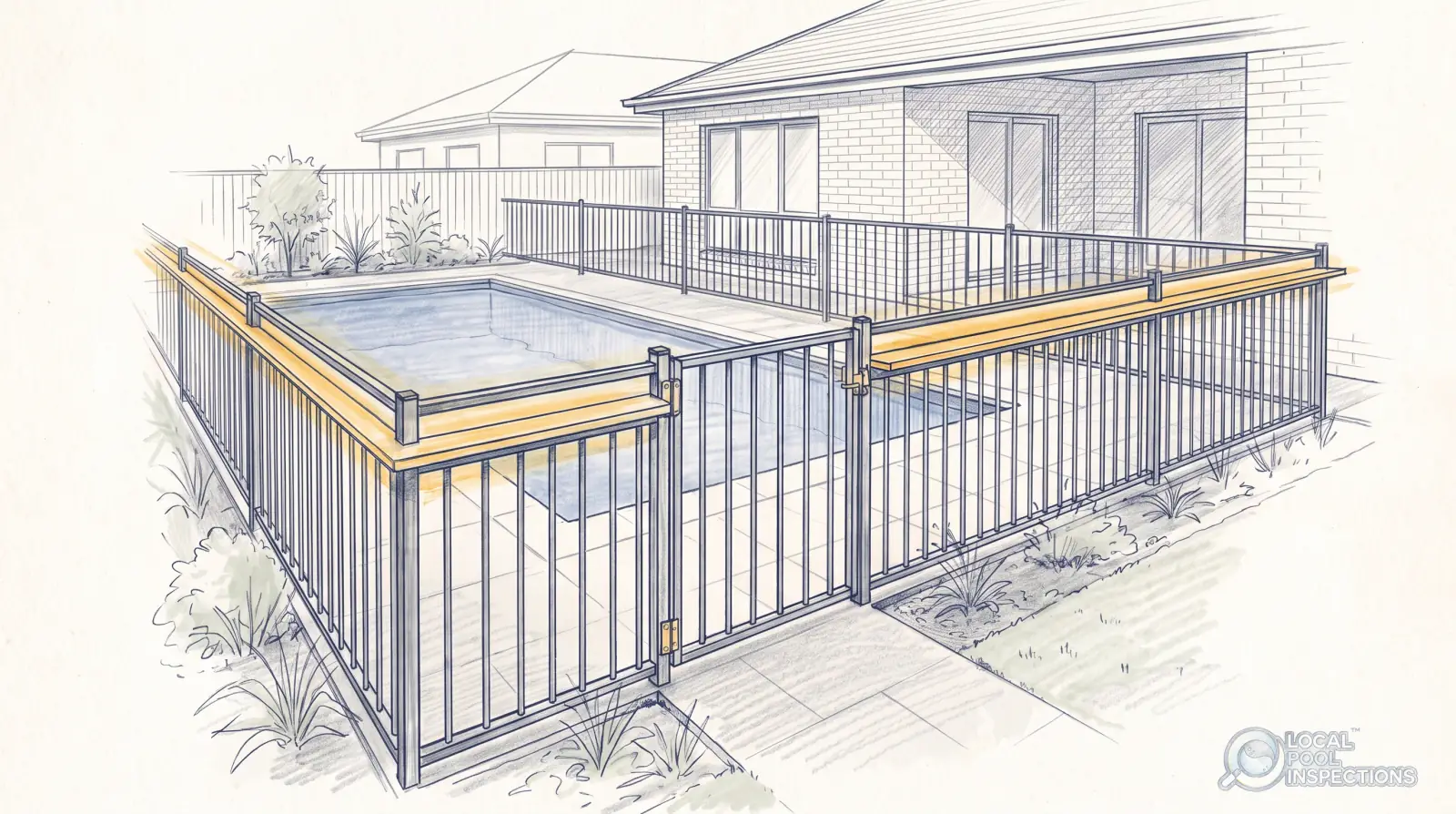
The NCZ is a quarter-circle swept from the top rail of your fence, running outward and then down on the outside — the side facing away from the pool. Its whole purpose is to deny a child the foothold they'd need to climb over from the outside. It is not measured from the pool side, and it is not a clearance zone floating above the fence. Half the pool-fence guides online get this reversed, so here it is plainly: arc, from the top, out and down, on the non-pool side. Which pool safety standard your barrier is measured against is the one recorded for your pool on the council register. The build era is council's guide to it, not the answer, and for most inspections it's AS 1926.1-2012.
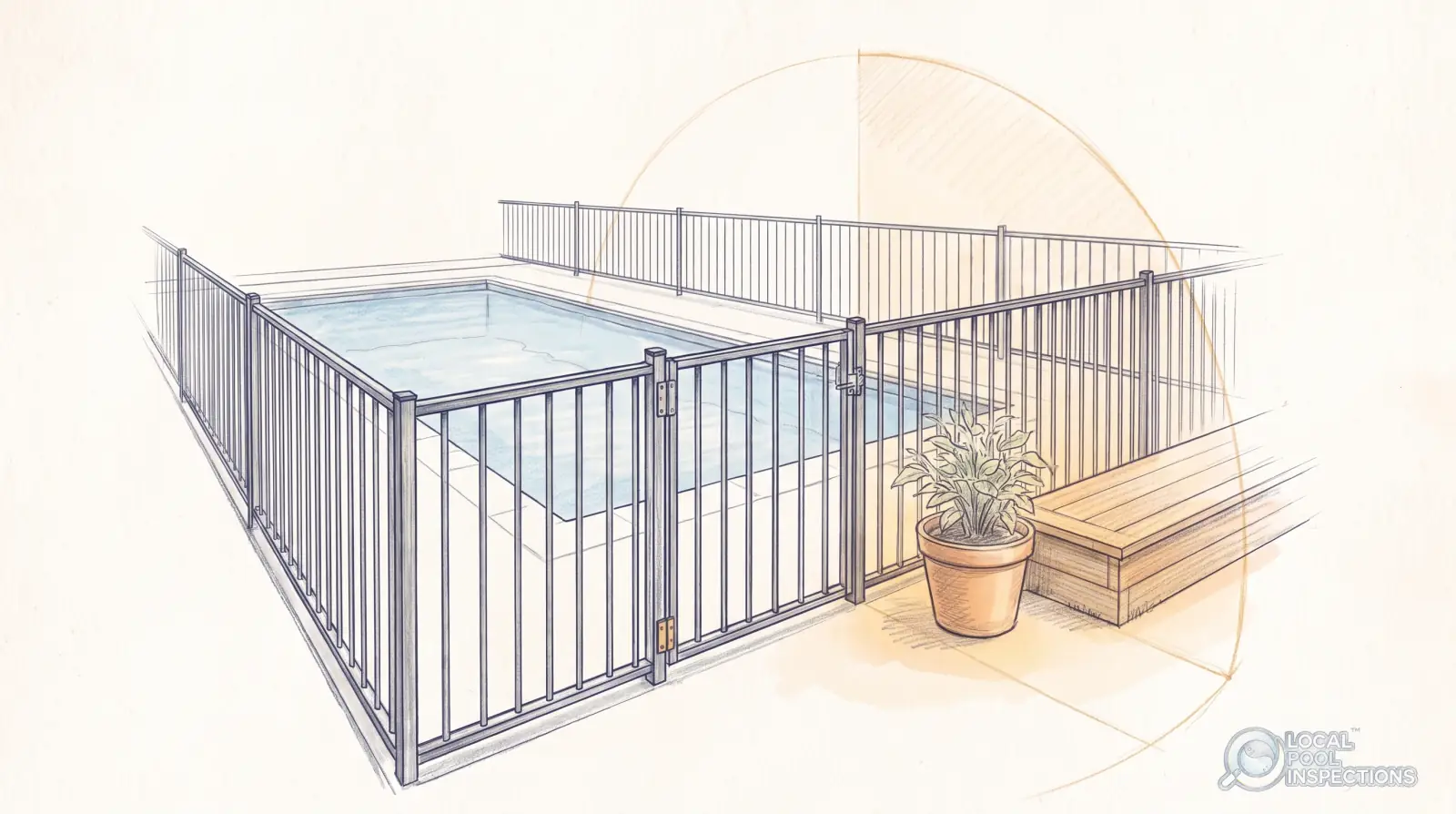
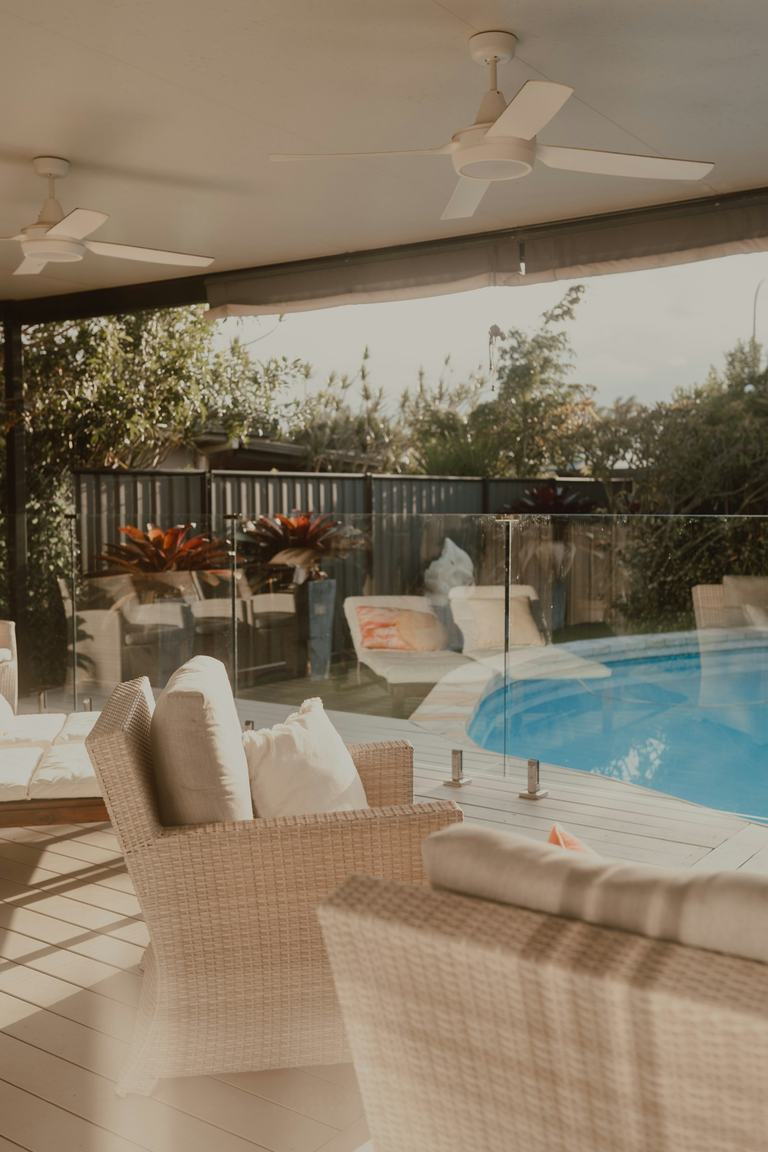
The radius depends on your pool's build era. It's 900 mm for pools built from 1 May 2010 onward, under the current standard, AS 1926.1-2012, which kept the 900 mm figure carried in from the 2007 edition. It's 1200 mm for pools built between 1 November 1994 and 31 July 1997, under AS 1926.1-1993. For pools built from 1 August 1997 to 30 April 2010 there is more than one possible answer — a barrier could lawfully have been built to the deemed-to-satisfy provisions or to a performance-based Alternative Solution, so your council confirms which applies. So the NCZ figure for your neighbour's newer pool may not be the figure for yours. We check a barrier against the radius that applied when it was certified — that's why the build date comes up before the tape measure does, and it isn't a shortcut for waving an old fence through. Our non-climbable zone (NCZ) 900 mm rule guide walks through the era boundary in more detail, and if your pool is older, our older inland Geelong pool issues post covers the NCZ fails we see most on pre-2010 barriers.
You'll also see a "300 mm above the barrier" rule quoted in older guides. There isn't one. The 300 mm figure that genuinely exists relates to climbable horizontal surfaces on the inside of the fence, not a clearance zone floating above the top rail.
What Are the Gate and Latch Rules?
Gates have to swing outward, away from the pool area. They have to self-close and self-latch from any starting position — even resting lightly against the latch — with nobody there to push them shut. And the gap under a closed gate can't top 100 mm.
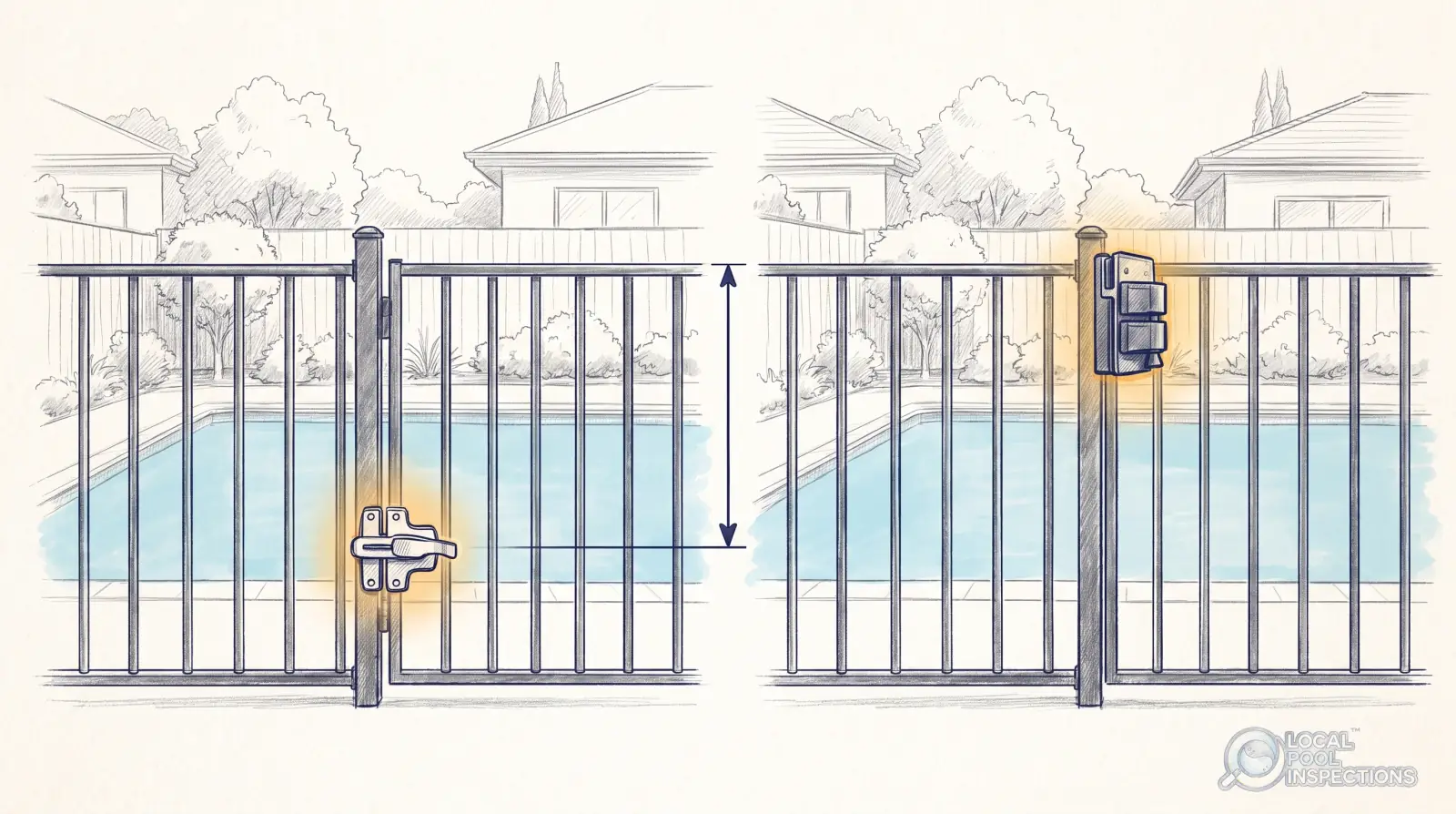
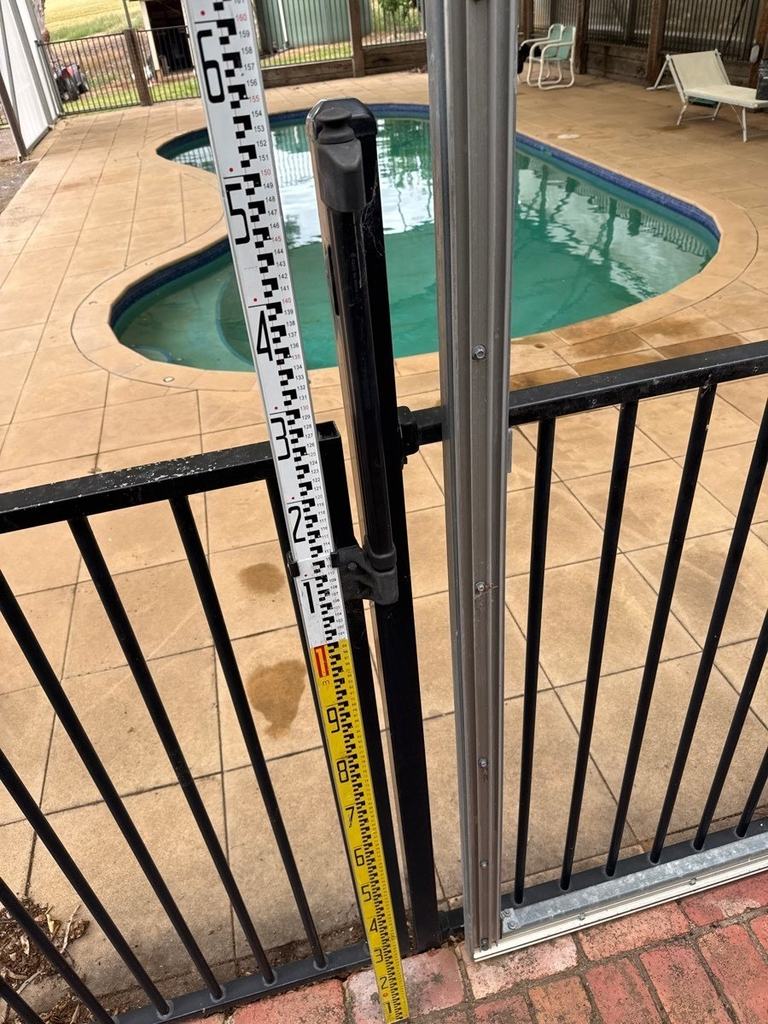
The latch release has two compliant paths, and this is where a lot of confusion sits. A release 1500 mm or higher above the ground needs no shielding. A release lower than that has to be shielded, so there's no opening bigger than 10 mm within roughly 450 mm of the mechanism. A low latch isn't automatically a fail. A low latch that's been properly shielded passes — our pool gate latch height 1.5 m rule guide sets out both paths side by side.
Most first-time failures trace back to the gate or its latch. A latch painted over one summer too many until it stops catching. A hinge that's dropped just enough that the gate rests a finger's width shy of closed. A DIY gate hung the wrong way round so it swings toward the water. Our pool gate self-close test guide covers how to check the swing and latch yourself before we arrive.
What Gaps and Spacings Get Checked?
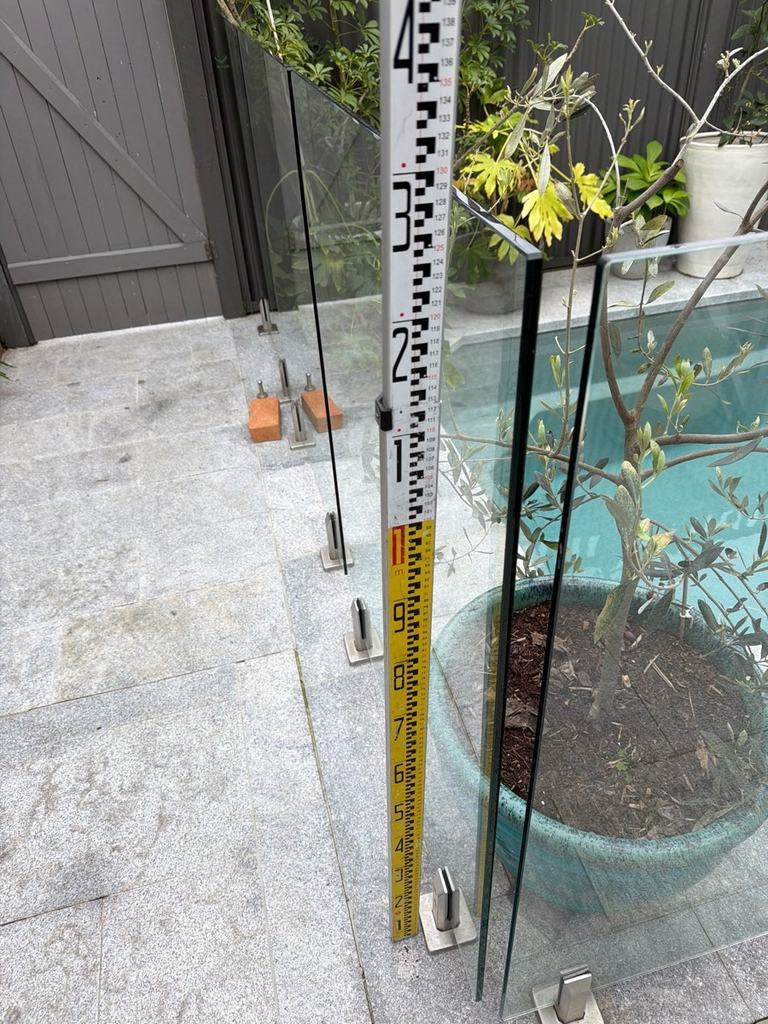
Three separate gap rules get measured, and they're easy to mix up. First, the gap between the bottom of the barrier and the ground: 100 mm maximum. Second, the gap between vertical members — palings, balusters, whatever your fence is made of — 100 mm maximum again. Third, the vertical spacing between climbable horizontal members on the outside face: 900 mm minimum apart. That last one runs counter to what people assume. You want those rails far apart, not close, so they can't stack up into the rungs of a ladder. Our pool fence vertical rail spacing guide covers this rule in more depth, including the fence styles that trip it up most often.
The Gap & Spacing Rules
- Under the barrier — 100 mm maximum to ground
- Between vertical members — 100 mm maximum
- Between horizontal rails — 900 mm minimum apart
- Fence height — 1200 mm minimum, from outside ground level
What Counts as a "Climbable Object" Near the Barrier?
Anything a child could turn into a foothold or handhold inside the non-climbable zone counts. It isn't a height test. You'll see a "600 mm" figure thrown around online; it simply isn't in the standard. What the standard asks is whether a surface is substantially horizontal and more than 10 mm deep, or whether it fails a 60-degree slope test under the current edition. The culprits are the ordinary things people set down by a fence: retaining walls, garden beds, pot plants, outdoor furniture, the air-conditioning unit, the pool pump. Whether any of them actually breaks the zone comes down to the exact geometry of your yard. That's a job for the tape measure on the day, not a blanket rule off a website.
What Happens if the Barrier Fails Part of the Inspection?
You get a written Non-Conformance Report that names exactly which component failed and why: a specific latch height, a specific gap measurement, a specific object in the zone, not a vague "doesn't comply." From there you arrange the repair with whichever trade fits the fault, whether that's a locksmith, a fencer, or just moving an object clear of the zone. Then we come back for our free re-inspections once it's sorted, with no extra charge on top of your original $250. Our failed pool inspection next steps guide walks through this process end to end.
A formal Form 24 is a separate escalation. It's a non-compliance notice lodged with the council, it can carry a fine, and it's kept for cases posing an immediate risk to life. It's not the routine first-time fail. See our non-conformance reports page for the full detail, or our re-inspections page for what the free follow-up visit covers.
Who Can Do a Pool Fence Inspection in Geelong?
In Victoria a pool fence — the barrier — can only be inspected and signed off by a registered building surveyor, a registered building inspector, a registered pool inspector, or your council's municipal building surveyor. Local Pool Inspections is a registered pool inspector working across Geelong, the Bellarine and Melbourne's west. A fencing contractor can build or repair the fence, but cannot certify it.
How Is a Barrier Inspection Different From a General Pool Safety Inspection?
Same visit. This page just zooms in on the barrier. Gates, latches, gaps, NCZ — that's where nearly every compliance issue actually lives. The water and the pool shell aren't part of a barrier inspection at all. For the wider picture — what an inspection costs, who's allowed to issue your Form 23, the four-year re-inspection cycle, and how to check an inspector's registration — head to our pool safety inspections Victoria page. And if you're planning a new pool or reworking the yard and want the barrier drawn up compliant before anyone digs, our compliance consultation service reviews the plan against the standard first.