

Certified by Ryan Gaw, VBA-registered Pool Safety Inspector
Licence IN-PS 100055 · Building Inspector (Pool Safety), licensed by the Building and Plumbing Commission (formerly the VBA)
What Does Pool Compliance Mean in Victoria?
Pool compliance means your pool or spa barrier meets AS1926.1, the Australian Standard Victoria enforces under the Building Act 1993 and Building Regulations 2018. It isn't one single measurement. It's a set of barrier points that all have to check out together: fence height, gate self-closing and self-latching, the latch's height off the ground, gap and rail spacing, and a non-climbable zone (NCZ) kept clear around the outside of the fence. Our pool safety barriers guide walks through each of those in detail, and our complete pool regulations guide covers the legislation behind them.
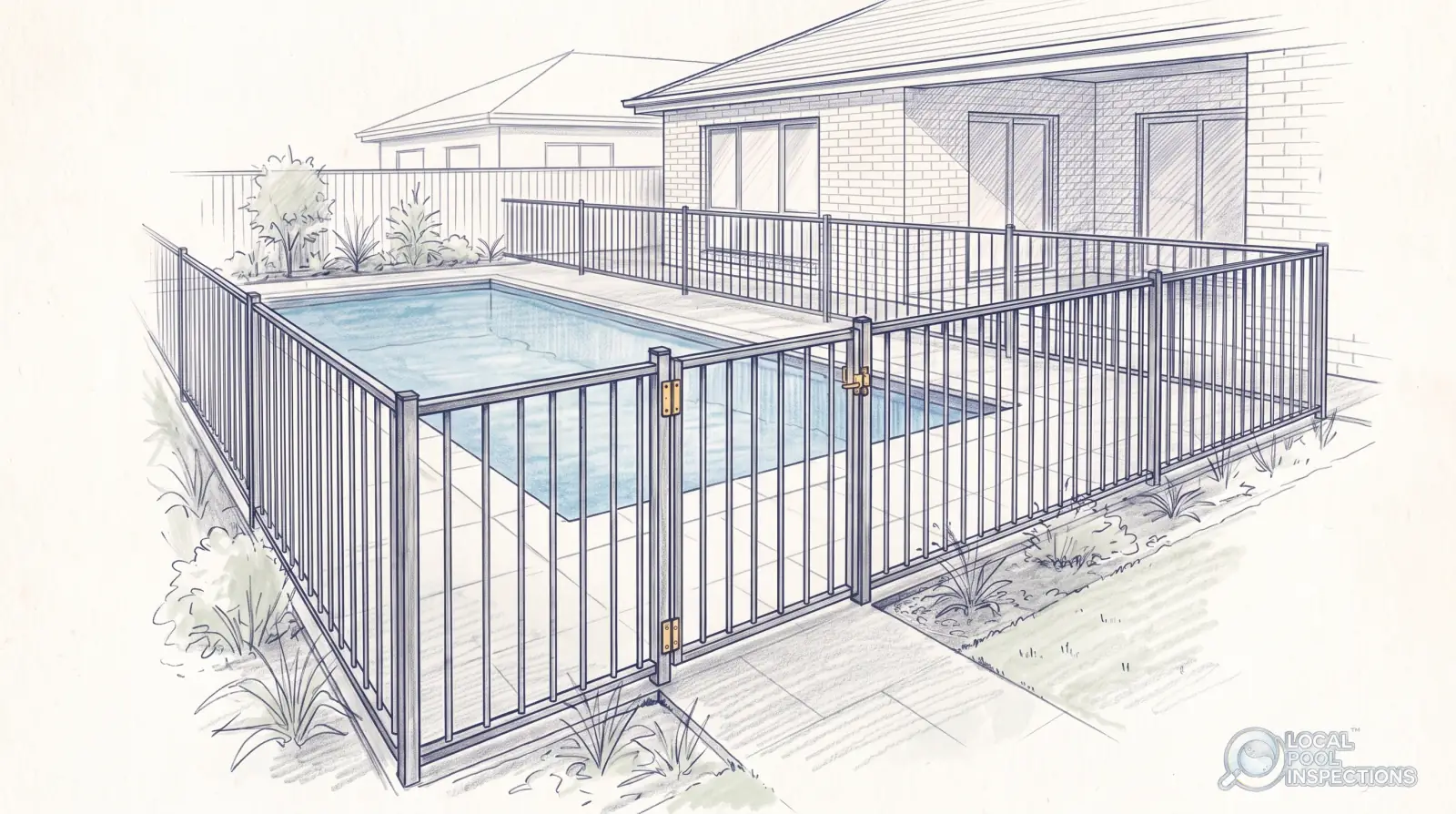
Compliance is assessed against the standard your pool was built under, not necessarily today's exact wording. Older pools are checked against the version current when the barrier was installed, with some points brought up to the current rules regardless. Compliance is a separate, later step to registering the pool with your council on Form 22 — register first, then a registered pool certifier measures all of it on-site. Pass, and you get the Victorian pool compliance certificate — the Form 23 Certificate of Pool and Spa Barrier Compliance — the same day. Fail, and you get a Non-Conformance Report listing exactly what to fix, with free re-inspections once it's done.
The Barrier Points Compliance Covers
- Fence height — at least 1200mm, measured from outside ground level
- Gate — self-closing and self-latching from every open position
- Latch height — release mechanism at 1500mm, or shielded if lower
- Non-climbable zone — a clear zone on the outside of the fence, 900mm under the 2007 and 2012 editions or 1200mm under the 1993 edition
How Do I Make My Pool Compliant?
Start by walking your own barrier against the standard. Most of the common fails are visible in a 20-minute check with a tape measure: a gate spring that's weakened, a pot plant or BBQ sitting inside the non-climbable zone, a latch that's drifted below 1500mm. Our swimming pool compliance checklist walks through the same points a registered inspector checks, so you know roughly where you stand before booking. If your barrier's boundary sits on a shared fence line, it's worth confirming which fence actually counts as your barrier. That one catches a lot of owners out.
Once you've self-checked and fixed anything obviously off, book a registered pool certifier for the formal inspection. If everything passes, your compliance certificate is issued that day. If something doesn't, you get a written Non-Conformance Report — not a fine, just a list — and once it's fixed, our free re-inspections get you across the line. If you'd rather get independent advice before committing to fence work or a new pool build, our compliance consultation service covers exactly that.
What Is a Certificate of Compliance?
A pool certificate of compliance is the document that proves your barrier passed. In Victoria, that's the Form 23. Some searchers know it as a swimming pool certificate of compliance, others as a "pool safety certificate" or "pool barrier certificate." They all describe the same document, issued by a BPC-registered Building Inspector (Pool Safety). There's no separate certificate type behind any of those search terms. For the full detail on what the certificate covers, how long it lasts and council-by-council lodgement, see our dedicated Victorian pool compliance certificate page and our Form 23 certificate page. Our blog's Form 23 explainer covers the legal detail if you want more background reading.
The certificate must be lodged with your council within 30 days of issue, and agents and buyers' conveyancers commonly ask for it when a property with a pool or spa is sold, even though it is not a statutory Section 32 component. Our Section 32 timeline guide maps out when to book relative to settlement.
How Do I Get a Pool Compliance Certificate in Victoria?
To get a pool compliance certificate in Victoria, check your pool or spa is registered with your council, book a BPC-registered Building Inspector (Pool Safety), and have the barrier inspected against the standard that applied when it was built. On a pass the Form 23 is issued the same day, and you lodge it with your council within 30 days.
- Check the registration. Every Victorian pool or spa deeper than 300mm must be on the council register; an unregistered pool cannot be certified. Our pool registration guide covers how.
- Book the inspection. $250 all-inclusive with Local Pool Inspections, same-day certificate on a pass. Book online or call.
- Have the barrier inspected against the right edition. Your barrier is assessed against the standard in force when it was built; your council confirms which one, and an alternative solution may apply to pools approved from August 1997.
- Pass or fix. On a pass, the Form 23 is signed the same day. On a fail, you get a written Non-Conformance Report, you fix the items, and the re-inspections are free.
- Lodge it. You lodge the Form 23 with your council within 30 days of issue; council charges a lodgement fee capped by the statutory maximum. Council-by-council detail is on our Form 23 page.
How Much Does Pool Compliance Cost?
With Local Pool Inspections, the inspection that assesses and certifies your pool compliance is $250 all-inclusive. That covers the on-site barrier assessment against AS1926.1, the Form 23 issued the same day if you're compliant, and free re-inspections if you're not. One flat fee, no callout charge, and the same price across Geelong, the Bellarine, Moorabool, Melton and Wyndham. See our pool inspection cost page for what sits inside and outside the fee, and the blog's breakdown of exactly what the $250 covers for the itemised list.
Two costs sit outside that flat fee. Council charges a small lodgement fee for the certificate once it's issued, capped by the statutory maximum; check the council-by-council breakdown on our Form 23 page, or confirm the current amount with your council directly. And if your barrier fails and needs actual repairs — a new gate spring, extra fence panels, moving something out of the non-climbable zone — that work is quoted separately by a licensed trade. We don't do the repairs ourselves, only the inspection and re-inspection.
How Often Do I Need to Renew Pool Compliance?
Victoria runs pool and spa barrier compliance on a statewide four-year re-inspection cycle. Every registered pool and spa barrier in the state comes up for re-inspection every 4 years, regardless of when the pool was built or when it was last certified. A Form 23 doesn't carry a fixed expiry date printed on it. It certifies your barrier was compliant on the day it was inspected, and the four-year cycle is what determines when the next check is due. Once a new certificate is issued, it has to be lodged with your council within 30 days.
Is a "Pool Compliance Certificate" the Same as a Form 23?
Yes. A pool compliance certificate is the Form 23, the same document under a different name. People find their way to it through four different searches: "pool compliance certificate," "swimming pool compliance certificate," "pool safety certificate," and "pool barrier certificate." Those are four labels for one piece of paper, the Form 23 Certificate of Pool and Spa Barrier Compliance. A BPC-registered Building Inspector (Pool Safety) issues it once your barrier passes against AS1926.1. Nothing else sits alongside it; there's no separate "compliance certificate" product to chase. Whichever term you typed, this is the document you're after.
| What you may see it called | Is it the Form 23? | What it means |
|---|---|---|
| Form 23, the Certificate of Pool and Spa Barrier Compliance | The official name | The approved form a registered inspector signs when your barrier passes. |
| Pool compliance certificate | Same document | The everyday name for the Form 23. |
| Swimming pool compliance certificate | Same document | The Form 23. It covers spas as well as swimming pools. |
| Pool safety certificate | Same document | The Form 23. The word safety is not in the official title. |
| Pool barrier certificate | Same document | The Form 23, named for what it covers. |
| Pool certificate of compliance | Same document | The Form 23, with the words in a different order. |
| Form 24, the Certificate of Pool and Spa Barrier Non-Compliance | Different document | Council-lodged, and kept for a barrier that poses an immediate threat to life or repair work that never gets finished. A routine fail gets a non-conformance report, then a free re-inspection, then the Form 23. |
What a Pool Compliance Certificate Confirms
- The barrier was assessed — fence height, gate, latch and non-climbable zone, each measured against AS1926.1 on the day
- It's a point-in-time record, not a licence — it certifies the barrier was compliant on the day it was inspected. There is no "valid for X years" window.
- You lodge it with your council — within 30 days of issue. We hand you the certificate; lodging it with the council is your step, and the council charges the lodgement fee.
- It's commonly requested alongside a Section 32 — when you sell a property with a pool or spa, agents and conveyancers commonly ask for the certificate, though it is not a statutory part of the vendor's statement
For the full breakdown — cost, the gap between re-inspections, and how lodgement works council by council — see our pool compliance certificate page for Victoria and Form 23 certificate page. Barrier not assessed yet? Book the inspection that produces the certificate: 0402 860 499 or book online.
Pool safety compliance in Victoria — what the certificate covers
Pool safety compliance in Victoria means your barrier passed every AS1926.1 check point and a registered inspector has issued the Form 23 pool safety certificate that proves it. We run pool compliance inspections across Geelong, the Bellarine, Moorabool, Melton and Wyndham, all at the same flat $250.
Pool compliance certificate vs pool certificate of compliance — same thing?
Yes — both names describe the one statutory document, the Form 23 Certificate of Pool and Spa Barrier Compliance. "Pool compliance certificate" and "pool certificate of compliance" are just two orderings of the same search, and a BPC-registered Form 23 pool safety certificate is what either search is actually after.
What Happens During Pool Inspections in Victoria?
The standard doesn't change from Geelong to Werribee to Bacchus Marsh. A pool inspection in Victoria runs the same way everywhere in the state; the only thing that shifts by location is which council you lodge the certificate with. A registered Building Inspector (Pool Safety) attends your property and works around the full barrier, measuring each point against AS1926.1 on the spot: fence height, gate self-close and self-latch, latch release height, non-climbable zone clearance, gap spacing. There's no lab work and no report written up back at an office afterwards. You hear the outcome while the inspector is still at your gate, and where it passes, your Form 23 is issued the same day. Compliance is the outcome this page covers; the inspection is the service that gets you there. To book one, or to see what happens on the day — who's allowed to inspect, what the inspector measures and what it costs — head to our pool safety inspections Victoria service page.
It's a statewide standard, enforced under the Building Act 1993 and Building Regulations 2018. So the four-year re-inspection cycle and the $250 all-inclusive fee hold whether your pool sits in Greater Geelong, on the Bellarine Peninsula, in Moorabool Shire, Melton or Wyndham. Lodgement is the part that's council-specific. Our Greater Geelong, Wyndham and Moorabool compliance pages set out how it works where you are.
What a Victorian Pool Inspection Covers
- The on-site barrier check — every AS1926.1 point measured in person, usually 30–45 minutes at the property
- If it passes — Form 23 issued the same day, $250 all-inclusive, nothing further owed to us
- If it doesn't — a written Non-Conformance Report listing the exact fixes, then free re-inspections once they're done
- Where we cover — Geelong, the Bellarine, Moorabool, Melton and Wyndham, one flat fee across the lot
Find your suburb on our full service area list, or go straight to a local page — Geelong, Werribee, Point Cook, Torquay, Bacchus Marsh, and many more across the areas we cover directly. Rather check your own barrier before you book? Our compliance checklist runs through the same points in plain language.
What Does a Pool Barrier Inspection Actually Check?
A pool barrier inspection is the hands-on part of compliance. It's where your fence, gate and the zone around them get physically measured against AS1926.1. "Pool compliance inspection," "pool safety inspection," "pool barrier inspection" — same job under each name. One visit, and the barrier either measures up or it doesn't. These are the five things the inspector is checking, tape and gauge in hand:
The Five Things a Barrier Inspection Measures
- Fence height — a minimum of 1200mm, taken from finished ground level on the outside (the non-pool side)
- Gate swing and self-close — it has to swing away from the pool and close and latch itself from any open position, without a hand on it
- Latch release height — a release at 1500mm or higher above the ground needs no shield; sit it lower and the release has to be shielded to AS1926.1's geometry
- Non-climbable zone (NCZ) — the arc swept out and down from the top of the fence, on the outside, has to be clear of anything a child could climb. The radius is era-specific: 900mm under the 2007 and 2012 editions (pools built from 1 May 2010), and 1200mm under the 1993 edition, which councils generally apply to pools built between 1 November 1994 and 30 April 2010. From August 1997 a barrier may have been approved under an alternative solution instead, so confirm with your council which edition applies.
- Gaps and rail spacing — no more than 100mm under the barrier or between vertical members, and climbable horizontal rails need at least 900mm of vertical spacing between them
The era rule on the NCZ is the one that trips up older barriers. A pool built in 2005 is usually measured against the 1200mm figure that applied when it went in (unless council records show it was approved under an alternative solution) — not the 900mm that covers newer pools — so a fence someone was sure was fine can fail on a clearance that was never wrong, just older. It's a common surprise on pre-2010 properties around Geelong and the Bellarine. Our non-climbable zone guide lays out the era-by-era detail, and our older Geelong pool issues post covers the fails that turn up most in pre-2010 barriers. For the regulatory background on recent changes, see our NCC 2025 explainer.
Want to run these checks over your own barrier first? Start with the swimming pool compliance checklist, then book the formal inspection: 0402 860 499 or book online.
Why Local Barriers Fail, and Why Timing Matters
Three things account for most of the fails we see on first inspection across Geelong and the Bellarine. Reactive clay soil moves the ground under fence posts — a post that was correctly set five years ago can have shifted enough to open a gap under the barrier. Sloping blocks need fencing that steps or follows the grade correctly; a barrier that looks fine on a flat run can fall short where the land pitches. And ageing barriers on older properties around Highton, Belmont and Geelong West often pre-date the current non-climbable zone rules — see the era-specific 900mm/1200mm figures above. Our why Geelong pools fail first inspection post and older inland Geelong pool issues guide cover the specific fixes for each.
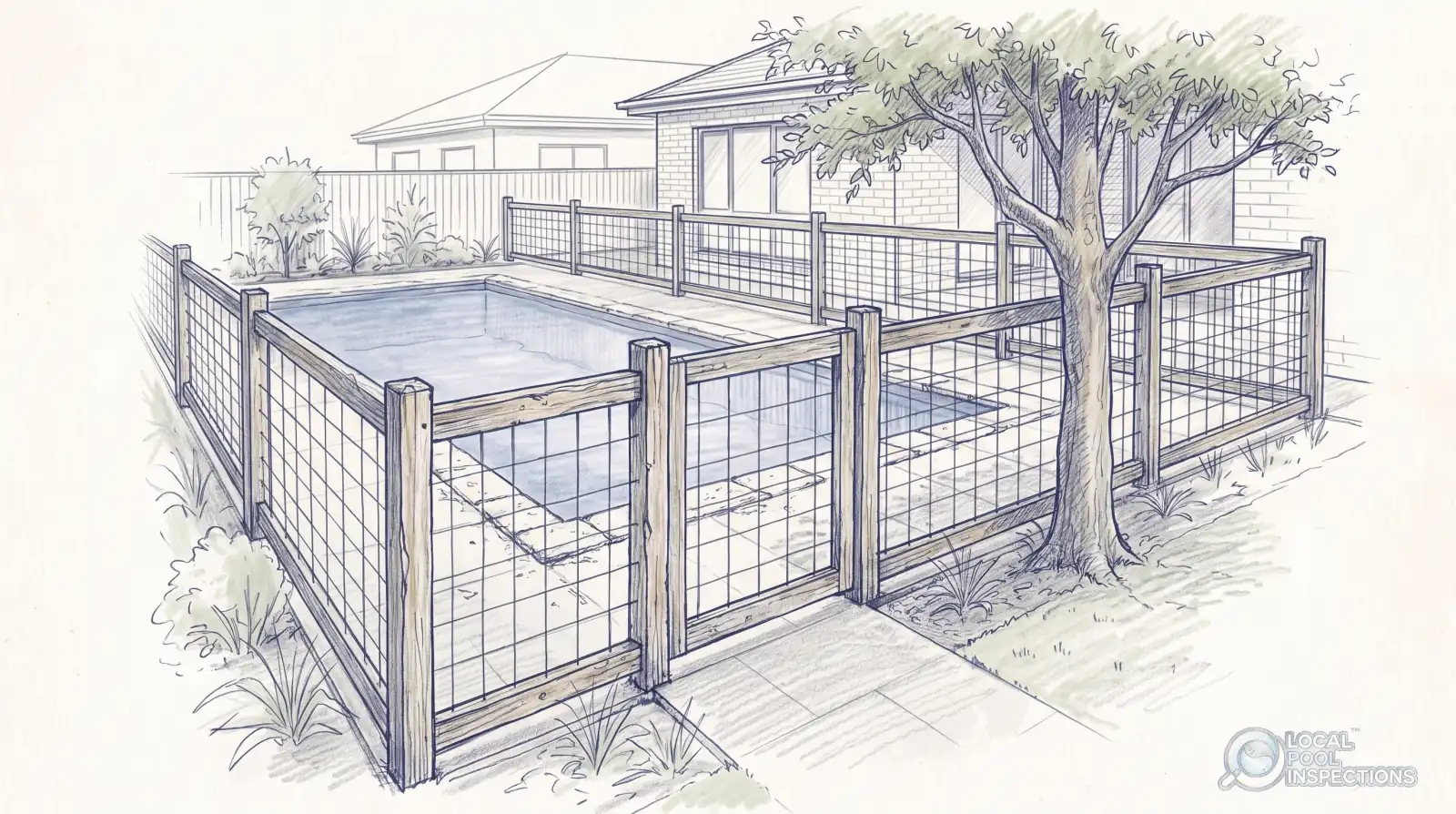
If a sale or lease is what's driving the inspection, book it early. The most common problem we see isn't a failed barrier — it's a seller who waited until settlement week to find out. Repairs take time to schedule, and a late discovery can shift the settlement date. Book when you list the property, not after you have a buyer. Our Section 32 timeline guide maps out when to book relative to settlement, and our pool inspection for a property sale page covers the process end to end. Inspecting a pool in Moorabool Shire specifically? Our Moorabool Shire pool inspection guide covers what's different there.
Renting Out a Property With a Pool
The owner, not the renter, registers the pool and arranges the barrier inspections and certificates. A renter can still check council's pool register.
Consumer Affairs Victoria sets out the rest. A fault with a pool or spa fence, gate or door is an urgent repair. For rental agreements entered into after 29 March 2021, the rental provider has to keep the barrier in good repair and give the renter a copy of the barrier compliance certificate if they ask for it. The renter has to report faults with the fence, gates or doors in writing. The CAV pool and spa safety page has the detail.
Letting the property as a short stay? Our short-stay rental guide covers that case.
Where to Go Next
Ready to self-check first? Run through our swimming pool compliance checklist. Want the step-by-step? See how to get a pool compliance certificate above. Need the full legal process, council-by-council? Head to our Form 23 certificate page. Not sure who's allowed to sign it off? Our pool certifier Victoria guide covers that. Want the component-by-component breakdown of gates, latches and the non-climbable zone? Our pool safety barrier inspections page walks through each one. Or see the full pool fence & barrier inspection services we offer.
Pool Compliance FAQs
What does pool compliance mean in Victoria?
How do I make my pool compliant?
What is a certificate of compliance for a pool?
How much does pool compliance cost?
How often do I need to renew pool compliance?
Is a pool compliance certificate the same as a Form 23?
What happens during a pool inspection in Victoria?
What does a pool barrier inspection check?
How do I get a pool compliance certificate in Victoria?
Does the pool inspector also do the repairs?
Where we assess pool compliance across Victoria
Ryan Gaw assesses and certifies pool compliance right across Greater Geelong and the Bellarine Peninsula, out to Moorabool Shire and Melton, and across Melbourne's western corridor. The Western Melbourne pool inspections hub lists Werribee, Point Cook, Tarneit and the rest of Wyndham and Melton's growth suburbs, and the full service area list has every suburb we cover. If your pool's an older one, our why Geelong pools fail first inspection post covers the most common compliance gaps we see, and our pool fence compliance guide covers the hardware and boundary rules in full.
Book your $250 all-inclusive pool compliance inspection
Same-day Form 23 where compliant, free re-inspections if you don't pass first time. Call 0402 860 499 or book online.