
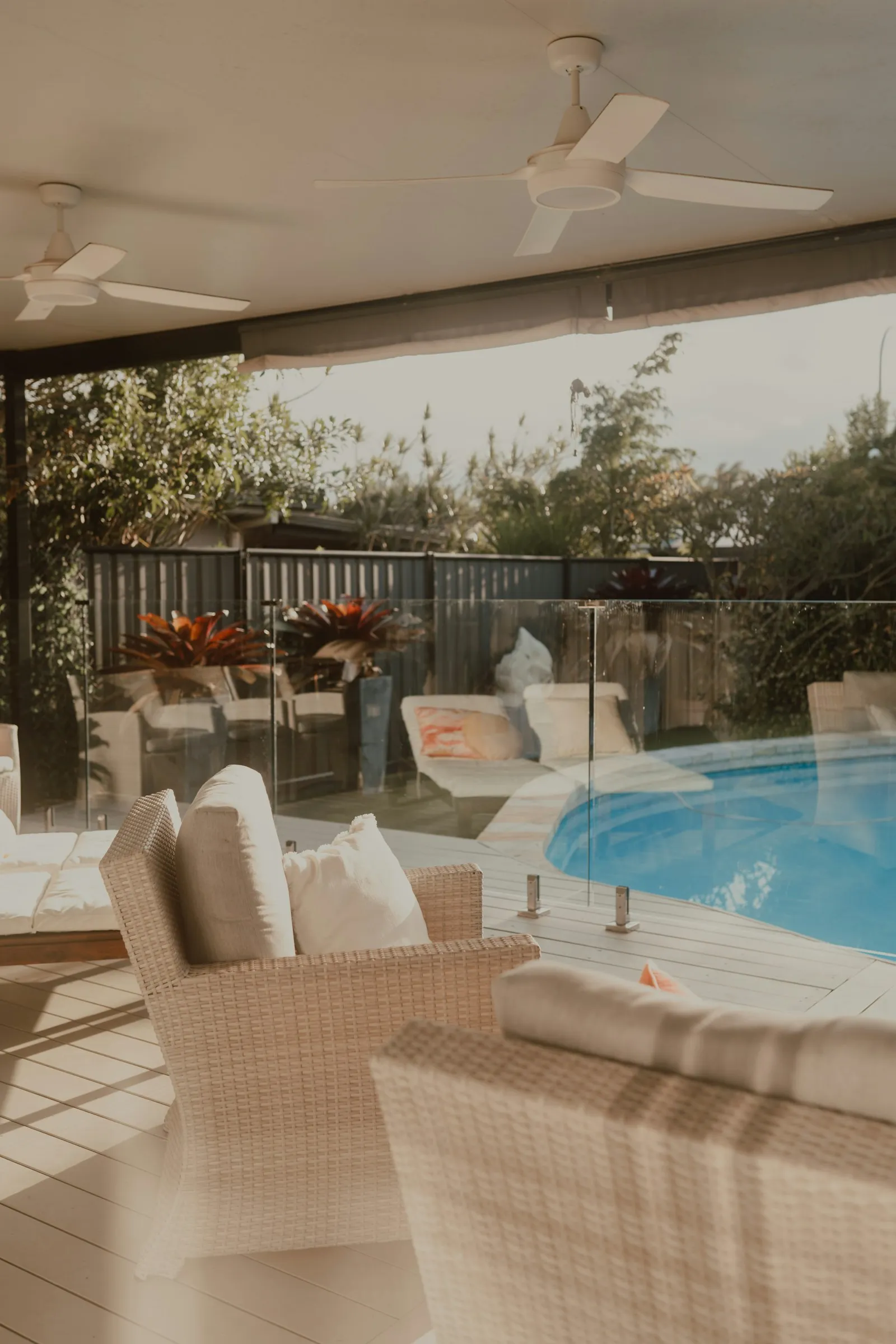
Short-stay hosting doesn’t exempt a Victorian pool from compliance; it sharpens it. Your property still needs a current Form 23, lodged with council within 30 days of issue and renewed every four years. What changes is your exposure. As a host you sit closer to a commercial operator, and a barrier that drifts out of compliance between bookings is your problem, not a guest’s. Here’s what hosts across Greater Geelong, the Bellarine, Moorabool and Wyndham need to stay on top of.
The Baseline: A Current Form 23
Under the Building Act 1993 (Vic) and the Building Regulations 2018 (Vic), every residential property with a pool or spa capable of holding more than 300 mm of water needs a current Form 23 Certificate of Pool and Spa Barrier Compliance. Short-stay rental sits on top of that obligation. It doesn’t replace it, and it doesn’t relax it.
For the certificate to do its job, it has to be:
- Issued by a VBA-registered pool safety inspector
- Lodged with your local council within 30 days of issue
- Renewed every four years (sooner if a council audit flags your property)
- On hand for your insurer, council, or a guest who asks
What’s Different About a Short-Stay Pool
The standard is identical. What’s different is the wear pattern and who’s standing at the gate. A short-stay pool sees more hands on the latch, less familiarity with it, and longer idle stretches between bursts of heavy use. Three things follow from that.
Heavy, lumpy gate use wears hardware faster
Holiday-let gates get hammered over peak periods (Christmas, Easter, the summer school holidays) then sit idle for weeks. That stop-start pattern is harder on hardware than steady daily use. A self-close spring that might last eight years on a family home can weaken in four or five on a busy short-stay property. And the gate is the single most common failure point we find on any pool, short-stay or not. Coastal salt air speeds it up further. Our note on Bellarine salt-air corrosion covers why barriers near the coast wear quicker.
The certificate has to be current during the stay
If your Form 23 lapses mid-booking and you haven’t renewed, the property is non-compliant while a guest is there. An insurer can lean on that if a claim arises. Book the renewal well before the expiry date rather than letting it run to the wire. And remember a fresh certificate still has to be lodged with council within 30 days.
A between-bookings barrier check pays for itself
Guests move things. A sun lounge dragged against the fence, a pot plant shifted into the wrong spot, a gate propped open with a brick and forgotten: any of it can turn a compliant barrier into a hazard between one checkout and the next cleaning visit. Before each booking, walk the pool zone and confirm:
- The gate self-closes from any open position and the latch engages every time
- Nothing has been moved into the non-climbable zone on the outside of the fence (typically 900 mm for pools built from 1 May 2010, or 1200 mm for pools built 1994–2010)
- No new footholds: pool equipment, a ladder, a crate, anything climbable left near the barrier
Plenty of hosts photograph the pool zone before each guest as part of the turnover, and those dated photos become evidence of due diligence if anything ever goes wrong. If a gate or latch isn’t behaving the way it should, don’t try to adjust or repair it yourself. Note it and have it checked by your inspector or a licensed installer. The 30-second self-close test walks through what a compliant gate should do.
Put pool safety in the house manual
Your welcome guide or house manual is the right place to set expectations:
- Children must be supervised at all times in the pool area
- The gate self-close is a safety device — it isn’t a broken hinge, so please don’t prop it open
- Nothing is to be moved against or near the pool fence
- Emergency contact details
Host Liability vs a Standard Homeowner
The real difference between owner-occupier and short-stay compliance is liability. Hosting guests for payment puts you closer to a commercial operator, and a guest injury on your property can expose you to claims that wouldn’t arise between two private parties. Insurers generally expect the property to be in current Form 23 compliance before they’ll honour a related claim, which makes the certificate part of your cover rather than just a council formality.
In practice, that means:
- Schedule the renewal at year three of the four-year cycle, not year four, so there’s a buffer in case the inspection turns up something to fix
- Act on any Form 24 non-compliance items straight away, not at the next renewal
- Keep dated photos of the barrier between bookings
- Have the gate hardware serviced by a competent installer if it’s getting stiff or slow to close
Council Audit Risk
Some Victorian councils run periodic audits of short-stay-listed properties to confirm Form 23 status, and Greater Geelong has been notably active on this. Here’s the part hosts often miss: if your listing shows a pool in the photos, council can cross-check your certificate against the Pool and Spa Register. Your own marketing becomes the audit trigger. An expired Form 23, or a pool that was never registered, can draw an infringement notice and a remediation order. That’s a far costlier outcome than a routine $250 renewal.
What the Form 23 Doesn’t Cover
The Form 23 inspection assesses the barrier against the Australian Standard. It is not a whole-of-property safety check, so it doesn’t address:
- Pool water quality (chlorine, pH, sanitation)
- Electrical safety of pool equipment
- First-aid and signage requirements
- Resuscitation chart display (good practice; council expectations vary)
Most platforms and host insurers expect a layered approach. The Form 23 covers barrier compliance; the rest is good-host practice. Our pool compliance checklist is a useful starting point before any inspection.
A Sensible Inspection Rhythm for Hosts
Given how short-stay gates wear, we suggest hosts run on:
- Form 23 every four years. The statutory minimum, no exceptions.
- An annual hardware look-over. A competent visual check of hinges, springs and latch operation, with anything faulty repaired by a licensed installer.
- A pre-booking walkthrough every stay. Five minutes, photographing anything that looks off.
FAQ
Does putting my pool home on Airbnb change my Form 23 obligations?
The underlying requirement is the same as any Victorian residential pool: a current Form 23, lodged with council within 30 days of issue and renewed every four years. Short-stay hosting doesn’t exempt you. If anything, the host liability that comes with paying guests makes keeping it current more important, not less.
How long is a Form 23 valid for?
A Form 23 has no validity period: it certifies the barrier complied on the day it was inspected. It must be lodged with council within 30 days of issue, and the pool comes up for re-inspection every four years. A new certificate must be lodged within 30 days of being issued. If it lapses while you have a guest staying, the property is non-compliant during that stay.
What if a guest moves something into the pool area between inspections?
That’s exactly why a pre-booking walkthrough matters. A lounge, pot or crate moved against the fence, or into the non-climbable zone on the outside of the barrier, can create a foothold for a child to climb over, even though the barrier passed its last inspection. Reset the area before the next guest and photograph it. If hardware like the gate or latch isn’t working properly, have it checked by your inspector or a licensed installer rather than adjusting it yourself.
Are short-stay pools inspected differently or charged more?
No. A short-stay property is inspected against the same standard and process as any residential pool, at the same flat $250 inc GST. The only practical difference is timing. Most hosts prefer a mid-week, off-peak slot so the inspection doesn’t clash with a guest stay.
Short-stay rental Form 23 — $250 all-inclusive
VBA-registered inspector across Greater Geelong, Bellarine, Moorabool and Wyndham. Off-peak scheduling available, same-day Form 23 where compliant, free re-inspections if remediation is needed.
Call 0402 860 499 or book online.