
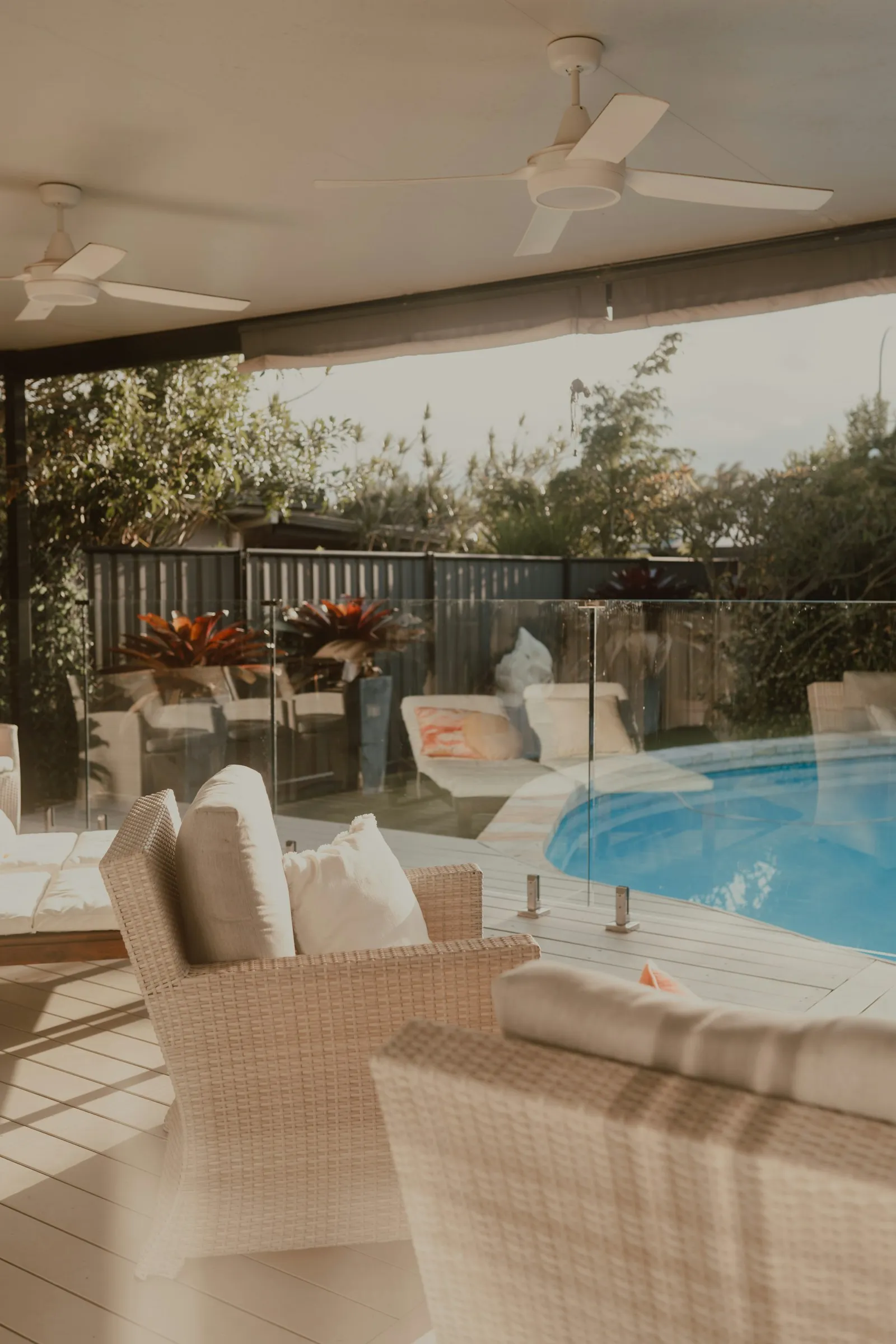
Plenty of Victorian pools use the back or side boundary fence as one side of the pool barrier, and that’s allowed. The complication is that the fence has a second owner. That muddies who has to fix it, whether the neighbour’s side counts, and who pays when it needs work. The answers sit in the Building Regulations 2018, the Fences Act 1968 and guidance from the Building and Plumbing Commission (formerly the VBA).
Who is responsible for a boundary fence that’s part of a pool barrier?
You are, as the pool owner. Regulation 147F of the Building Regulations 2018 requires the owner of the land where the pool is located to take all reasonable steps to keep the barrier properly maintained.
The Building and Plumbing Commission spells out the boundary case. Where the barrier relies on a shared fence, it says this “does not become a shared responsibility” with your neighbour. The adjoining owner isn’t responsible for the compliance or maintenance of that fence as your pool barrier. It sits with you alone. The Fences Act still governs it as a dividing fence, and that’s where cost comes in.
What does the boundary fence have to meet?
For barriers installed from 1 May 2013, the regulator’s guidance (Practice Note SP 02 and self-assessment Checklist 3) sets two boundary-specific requirements:
- At least 1800 mm high, measured on the inside (the pool side).
- A non-climbable zone on the pool side: a 900 mm quadrant measured down from the top of the inside of the fence. Nothing climbable can sit in that space.
The checklist diagram labels the outside of a boundary barrier “may be climbable”. So on a fence built to those rules, it’s your side I’m checking: the height, and whether anything in that top 900 mm on the pool side gives a child a hold. The general barrier requirements, such as gaps, apply to it like any other section of the barrier.
Barriers built between 1 May 2010 and 30 April 2013 went up under the 2007 edition of the standard, where that zone could be on either side. Older pools are assessed against the standard that applied when they were built, so check which one council’s register lists for your pool. The non-climbable zone guide covers the other zones.
What if the neighbour puts something against the fence?
Under the rules for barriers built from 1 May 2013, anything on the neighbour’s side sits outside the boundary non-climbable zone, because that zone is on the pool side. That’s as far as the published guidance goes. I haven’t found anything from the regulator or a council that deals specifically with a neighbour’s lattice, plants or shed against a pool boundary fence, so if that’s your situation, ask about your own fence rather than assume. If growth comes over the top into that 900 mm on your side, though, it’s yours to deal with, like anything else on the pool side.
Who pays when the fence needs work?
The Fences Act 1968 covers dividing fences, and it doesn’t mention pools. Section 7 has neighbours contribute in equal proportions to a sufficient dividing fence. If one owner wants a fence above that standard, section 8 makes that owner liable for the extra. For a residential property, the Victorian Government’s fencing guidance says a sufficient dividing fence might be a 1.8 metre timber paling fence.
Put those together and, where the pool barrier needs more than a sufficient dividing fence would, the difference is likely to fall to the pool owner. That’s a reading of section 8, not something the Act says about pools, so get advice on your situation if the amount matters.
The Fences Act process starts with a Fencing Notice, and your neighbour has 30 days to respond. Skip the notice and any dispute is settled under contract law instead. If you can’t agree, the Dispute Settlement Centre of Victoria offers free, voluntary and confidential mediation. Fencing disputes are decided in the Magistrates’ Court, not VCAT.
Do you need a building permit to fix or replace it?
It depends on the work, so check before anything comes down. The general permit exemption for fences in the Building Regulations doesn’t cover a fence that forms part of a pool barrier. There is an exemption for replacing or altering part of a barrier to fix a non-compliance found at an inspection. It doesn’t apply if the work involves posts or footings, more than half the barrier’s length, materials not commonly used for that purpose, or a change to the barrier’s length or area, among other limits. Your council or a building surveyor can tell you where your job sits, and this guide to barrier repairs and permits goes into more detail.
What should you check before the inspection?
- Measure the fence on the pool side. For a barrier installed from 1 May 2013 it needs to be at least 1800 mm.
- Look along the top 900 mm on your side for plants, hooks, taps, pergola beams or anything else a child could use.
- If you and the neighbour are planning fence work, settle the permit question first.
If the barrier doesn’t pass, the report says what needs to change. If you think the result is wrong, this page sets out your options.
Boundary fence part of your pool barrier? Book a Form 23 inspection: $250 all-inclusive
Registered pool safety inspector across Greater Geelong, the Bellarine, Wyndham, Moorabool, Melton and the Surf Coast.
Call 0402 860 499 or book online.
Boundary fence questions
Is my neighbour responsible for the boundary fence that forms my pool barrier?
No. The owner of the land where the pool is must take all reasonable steps to keep the barrier properly maintained (regulation 147F of the Building Regulations 2018). The Building and Plumbing Commission says a shared fence the pool owner relies on as a barrier does not become a shared responsibility. The adjoining owner is not responsible for its compliance or maintenance.
How high does a boundary fence need to be for a pool in Victoria?
For barriers installed from 1 May 2013, at least 1800 mm on the inside, with a 900 mm non-climbable zone measured down from the top on the pool side. Older barriers are assessed against the standard that applied when they were built.
Can my neighbour’s side of the boundary fence be climbable?
For barriers installed from 1 May 2013, yes. The regulator’s checklist labels the outside of a boundary barrier as ‘may be climbable’, because the non-climbable zone for a boundary fence is on the pool side.
Does my neighbour have to pay half for a pool-compliant boundary fence?
The Fences Act 1968 splits the cost of a sufficient dividing fence equally between neighbours, and an owner who wants more than that pays the difference (sections 7 and 8). The Act doesn’t mention pools, so anything needed only for the pool barrier is likely to be the pool owner’s cost.