
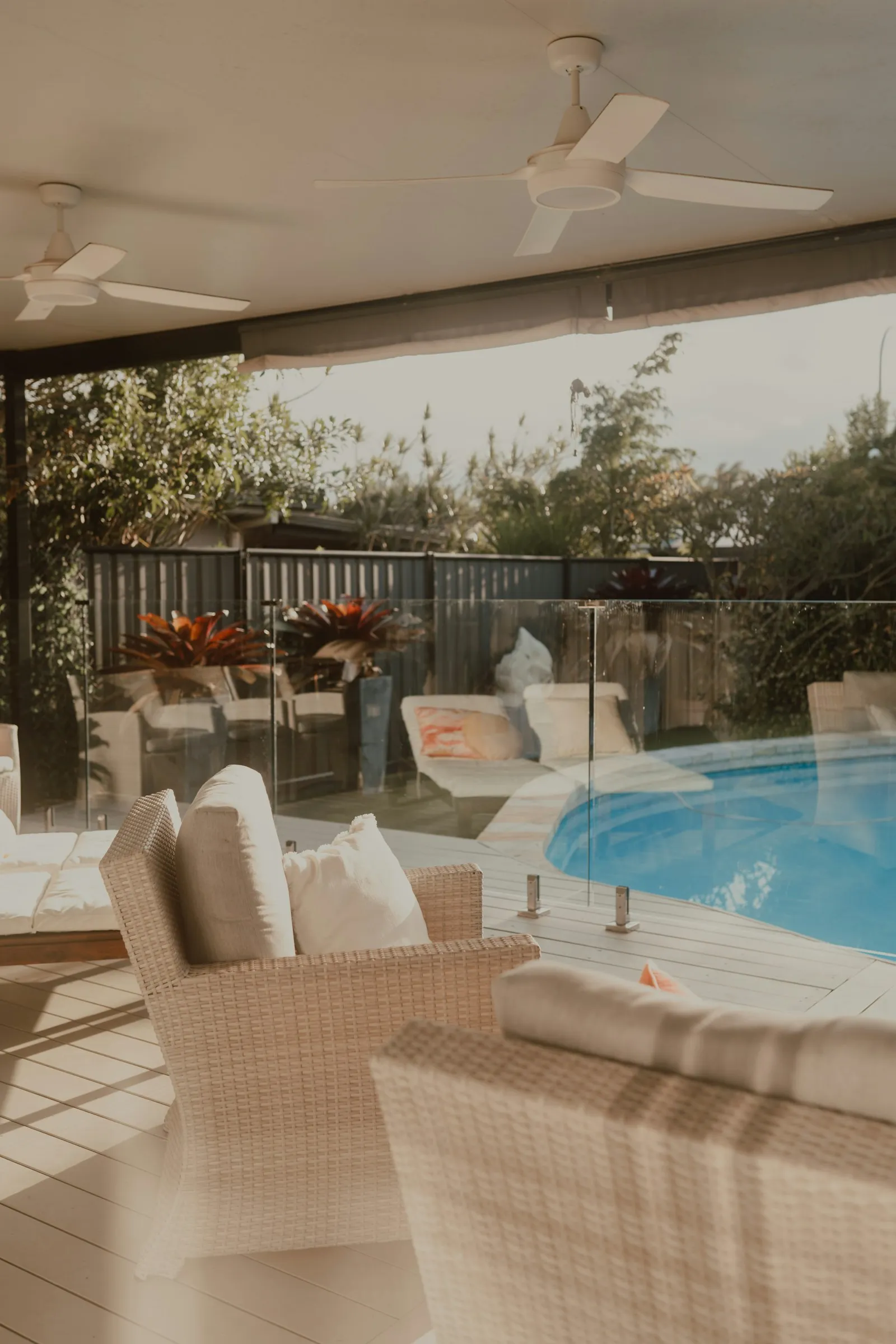
Related reading: Pool Safety in Victoria and Pool Regulations Victoria. Once the spa barrier complies, the paperwork council wants is a certificate of barrier compliance.
If your outdoor spa holds water deeper than 300 mm, it needs a Form 23 Certificate of Pool and Spa Barrier Compliance, the same certificate a swimming pool needs. It’s assessed against the same Australian Standard, by the same pool safety inspection, at the same $250 inc GST flat rate. 300 mm isn’t much water, so the rule catches almost every spa, whether it’s built in, portable or inflatable. Only foot spas and shallow decorative features sit under it.
The 300 mm Depth Threshold
Under the Building Regulations 2018 (Vic), barrier-compliance obligations apply to swimming pools and spa pools — any body of water capable of being filled to more than 300 mm deep. Most spas clear that line without trying:
- Built-in and permanent outdoor spas — typically 600–800 mm internal depth, well over the threshold
- Portable spas (e.g. Lay-Z-Spa) — usually 600–700 mm deep when filled, over the threshold
- Hot tubs and swim spas — over the threshold
- Foot spas, decorative spas and shallow plunge features — under 300 mm, so no Form 23 required
If your spa, filled to its normal level, holds water deeper than 300 mm at any point, Form 23 applies. Not sure whether yours crosses the line? Ask us before you book and we’ll tell you either way.
What’s the Same as a Pool Inspection
On the inspection itself, a spa and a pool barely differ. The barrier is checked against the same Australian Standard your spa was built to, and the certificate that comes out the other end behaves identically:
- The same AS 1926.1 barrier checks — height, ground clearance, gaps, gate self-close and self-latch, latch position, the non-climbable zone, and access from adjacent windows and doors
- Registration on your council’s Pool and Spa Register
- Form 23 lodged with council within 30 days, with re-inspection on Victoria’s four-year cycle of issue
- $250 inc GST flat rate with Local Pool Inspections, free re-inspections if remediation is needed
- The same VBA-registered inspector
For the full breakdown of what the certificate covers and how lodgement works, see our complete Form 23 guide.
Who Certifies a Brand-New Spa
This is the part owners most often get wrong about who to call. If your spa went in as part of a new build or a recent permit, the building surveyor overseeing that work certifies the barrier and issues the first Form 23, as part of the build certification. It isn’t something a private inspector hands out at that stage.
Where Local Pool Inspections comes in is everything after that: the four-year re-inspection cycle every spa needs once it’s certified, and the fresh Form 23 you’ll need when you sell. If you’ve just had a spa installed and don’t have the certificate yet, chase your builder or surveyor rather than booking a private renewal — that’s not the document you need at this stage.
What’s Different About a Spa
A smaller barrier, but the same standard
A spa in its own enclosure usually has a much smaller barrier than a pool, sometimes only a couple of metres a side, which makes for a quicker walk-around. The standard behind it doesn’t shrink to match, though. Every requirement gets checked the same way it would on a 20-metre pool fence, so plan on a normal inspection either way. If you want to see exactly what an inspector runs through, our Victorian pool and spa barrier checklist walks through each one.
A spa cover is not a barrier
Of all the spa misunderstandings I correct on site, this is the most common. A locked, lockable cover is worth having for heat and for keeping debris out, but it does not meet the safety requirement on its own. A compliant barrier still has to enclose the spa. A cover sitting on top of an otherwise unfenced spa will fail an inspection.
Indoor spas are a special case
An indoor spa in a dedicated room can be treated differently from an outdoor one if the room genuinely controls access. The exemption isn’t automatic, though, and most “indoor” residential spas are actually in sun-rooms or conservatories with sliding-door access straight off a living area. Those usually still need a compliant barrier. Whether yours qualifies depends on the specifics, so flag it at booking and we’ll confirm what applies.
Portable and inflatable spas still count
Not being bolted to the ground doesn’t make a spa exempt. If it holds more than 300 mm of water and stays set up, it needs a compliant barrier and council registration like any other spa — the soft walls of a Lay-Z-Spa change nothing. Councils differ on how long a “temporary” spa can sit before they treat it as permanent, so check your registration is in order before you book.
The spa often sits closer to the house
Spas usually end up against the deck or just outside the back doors, where a pool would never fit. That puts window-and-door access from the house front and centre, more so than with most pools. A door or a low window opening straight into the spa enclosure has to meet the access rules as well, and on a tight spa setup there’s often no room to move the spa instead.
Where Spa Barriers Most Often Fail
On spa jobs around Geelong, the Bellarine and Wyndham, a few problems account for most of the non-compliances I write up. They nearly all come back to where the spa sits: in the middle of an entertaining area. Furniture and equipment drift toward the fence over a couple of seasons, and a barrier that passed at handover quietly stops passing.
Outdoor furniture in the non-climbable zone
Chairs, side tables and BBQ trolleys get parked against the spa fence, landing inside the non-climbable zone (NCZ) — the clear zone on the outside (non-spa) side of the barrier, swept as an arc from the top of the fence, that a child could otherwise use to climb over. The NCZ is 900 mm for spas built from 1 May 2010 and 1200 mm for those built 1994–2010. Anything in that zone a child could stand on is a breach.
Step units and equipment against the fence
There are two repeat offenders here. The first is the set of entry steps a lot of spas ship with; dropped next to the gate, they hand a child a foothold straight up the fence. The second is the pump and heater, which every spa needs and which almost always get pushed hard against the enclosure so they’re easy to reach. Both end up inside the zone, and both are a fail. What the fix looks like depends on your layout and the standard your spa was built to, so the inspector pins down exactly what has to move. Sliding it over a foot is rarely the answer.
Latch position on a small gate
Spa gates often end up with the latch fitted at a comfortable adult height rather than where the standard puts it. On a typical gate the release sits at least 1500 mm above the ground on the outside. That’s the height where it needs no extra shielding. Put it lower and you’re into specific shielding requirements. A low, unshielded latch on a small spa gate is easy to miss and a common reason a spa fails.
Selling a Spa-Only Property
At sale, a spa carries the same obligations as a pool. A current Form 23 is commonly requested around the Section 32 vendor statement, though it isn’t a statutory Section 32 component, and a missing or expired one holds things up exactly the way it would for a house with a pool out the back. If you’re selling and the spa’s certificate has lapsed, that’s the pre-sale inspection we do.
Pricing
$250 inc GST, flat — the same as a pool inspection. If you have a spa and a separate pool, each with its own enclosure, see our guide to properties with more than one pool or spa for how the certificates and registration work, and the pre-inspection checklist for what to look at before we arrive.
FAQ
Does my portable spa really need a Form 23?
If it holds water deeper than 300 mm when filled and stays set up, yes — the same barrier and registration rules apply as for a built-in spa. Foot spas and shallow features under 300 mm don’t need one.
Does a locked spa cover count instead of a fence?
No. A lockable cover is good practice for heat and debris, but it doesn’t satisfy the safety requirement. A compliant barrier still has to enclose the spa.
Who issues the first Form 23 on a newly installed spa?
The building surveyor overseeing the install certifies the barrier as part of that work. Local Pool Inspections handles the ongoing four-year re-inspection cycles and the pre-sale Form 23 after that, not the initial certification.
How much does a spa inspection cost?
$250 inc GST, the same flat rate as a pool, with free re-inspections if remediation is needed.
Do I need a permit for a spa in Victoria?
Two obligations always apply: a spa that holds water deeper than 300 mm must be registered with your council and have its barrier certified on a Form 23, the same as a pool. Whether the installation itself needs a building permit depends on the spa, its barrier and your council, so ask the council or your building surveyor before it goes in.
Does a plunge pool need a compliance certificate?
Yes, if it can hold more than 300 mm of water, and any plunge pool deep enough to sit in can. The 300 mm test decides it, not what the product is called. It needs a compliant barrier and a Form 23 every four years like any pool. Only shallow plunge features under 300 mm fall outside the rules.
Do hot tubs and swim spas need a fence in Victoria?
Yes. A hot tub or swim spa that can hold more than 300 mm of water needs a compliant barrier and a Form 23 every four years, the same as a pool, and a lockable cover doesn’t replace the barrier. We inspect spas across Geelong, the Bellarine, the Surf Coast, Moorabool, Melton and Wyndham for the same $250.
Spa Form 23 — $250 all-inclusive, same as a pool inspection
VBA-registered. Renewals and pre-sale spa inspections across Greater Geelong, Bellarine, Moorabool and Wyndham. Free re-inspections if remediation is needed.
Call 0402 860 499 or book online.