
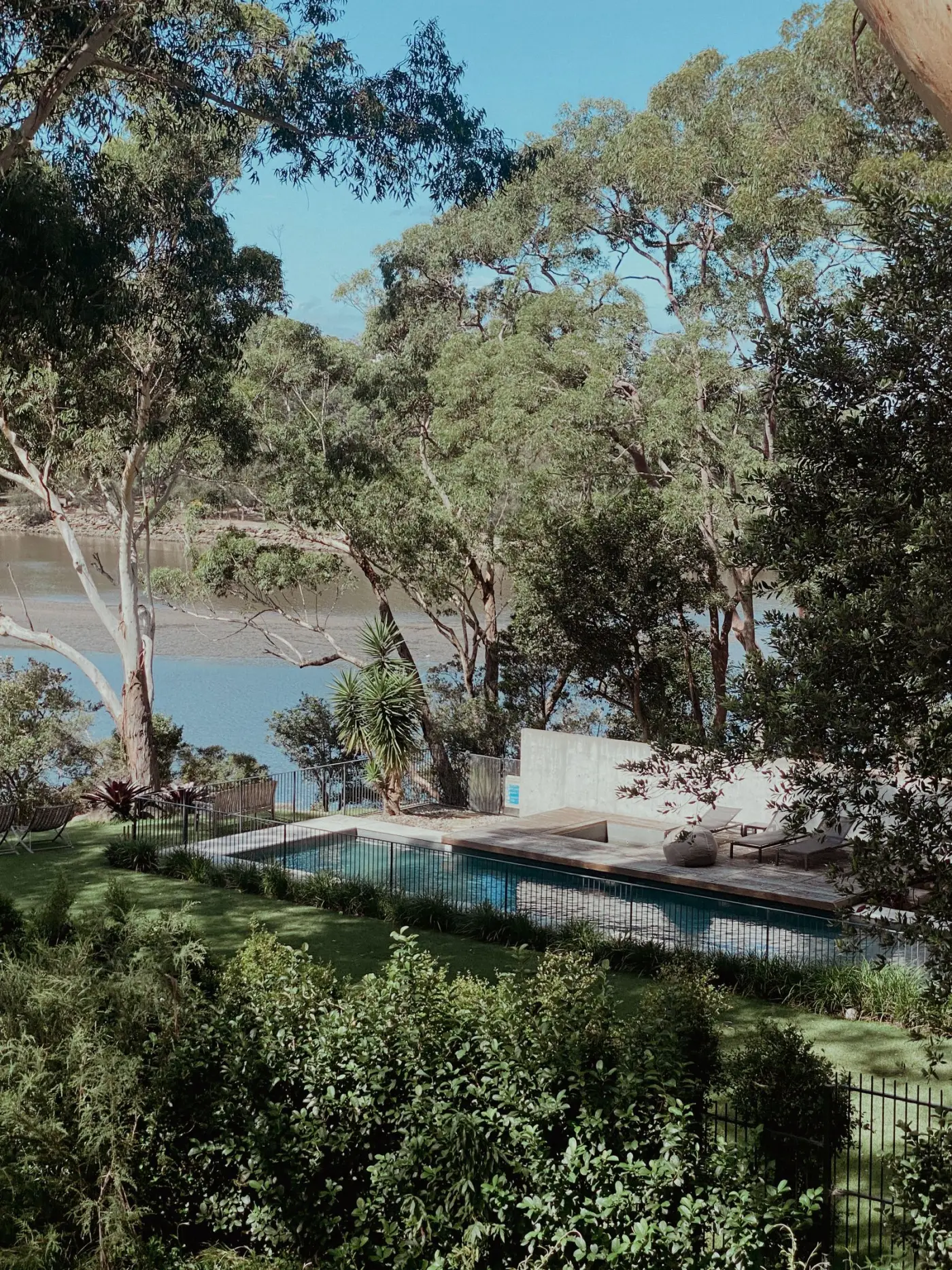
Across Greater Geelong, the Bellarine Peninsula, Moorabool Shire, and the City of Wyndham, roughly 60% of pool barriers fail their first Form 23 inspection. The reasons aren’t random — a handful of recurring issues account for over 80% of failures, and most of them are fixable in a weekend. This is the failure-pattern data we record at Local Pool Inspections, drawn from hundreds of inspections across the corridor.
#1: Worn Gate Self-Close Springs (≈ 35% of fails)
The single most common reason a Geelong pool fails Form 23 isn’t fence height, NCZ, or hardware — it’s the self-close mechanism on the gate failing to close from cracked-open positions. AS 1926.1-2012 requires the gate to close from any open angle, including 5° barely-open. Most older gates close fine from 90° or 45° but lose the spring tension to close from 5°.
Fix cost: $30–$80 spring + 15-min DIY install, OR $150–$220 magnetic latch upgrade.
#2: Non-Climbable Zone Breaches (≈ 25% of fails)
Mature plantings, pool pumps, retaining walls, raised garden beds — anything climbable within the non-climbable zone on the outside (non-pool) side of the fence (900 mm for pools built from May 2010; 1200 mm for pools built 1994–2010). The most common NCZ breaches we see in Geelong:
- Camellias, photinias, palms grown into the non-climbable zone (1200 mm for pools built 1994-2010; 900 mm from May 2010) in older Newtown / Highton / Belmont gardens
- Pool pumps, filters, and chlorinators placed against the outside (non-pool) fence line where they create a foothold within the non-climbable zone
- Built-in seating along the outside (non-pool) face of the fence that gives a child a foothold within the non-climbable zone
- Decorative retaining walls or other climbable surfaces on the outside (non-pool) side within the non-climbable-zone arc measured from the top of the fence (1200 mm for pools built 1994-2010; 900 mm from May 2010)
Fix cost: highly variable — $50 (one trim) to $2,000+ (relocate mature plantings). NCZ is the most expensive remediation category on average.
#3: Latch Height Below 1500 mm (≈ 10% of fails)
Latch drift caused by ground level changes — paving, mulch buildup, soil heave, or post settlement. The original 1500 mm latch is now at 1480, 1470, or lower. A latch below 1500 mm fails unless it is shielded (no opening greater than 10 mm within a 450 mm radius); above 1500 mm no shield is required.
Fix cost: $80–$150 (latch relocation) or $150–$280 (magnetic latch upgrade) or $0 (just remove built-up paving outside the gate).
#4: Gap Under Fence Exceeding 100 mm (≈ 10% of fails)
Erosion, soil settlement, and landscape changes opening up gaps under the bottom of the fence. Most common on sloped sites where the fence steps down — the gap opens up on the downhill side after a few years of soil movement. Also common around tree roots.
Fix cost: $50–$200 (regrading or installing skirt board along the bottom of the fence).
What’s Left? (the remaining ≈ 5%)
Fence height (under 1200 mm) accounts for some of the remainder, particularly on sloped sites. Window/door access points, vertical rail spacing, and hardware corrosion catch the long-tail.
Failure Patterns by Suburb Era
Older inland Geelong (1970s–90s housing)
Newtown, Highton, Belmont, Grovedale, Hamlyn Heights. Failure mix: heavy on NCZ from mature gardens (#2) and worn hardware (#1), plus older horizontal-rail fencing that often needs replacement.
Coastal Bellarine (mixed era)
Ocean Grove, Barwon Heads, Point Lonsdale, Portarlington. Failure mix: heavy on hardware corrosion from salt-air, gate self-close issues from corroded hinges (#1).
Newer Bellarine estates (post-2005)
Curlewis, Drysdale (newer parts), Clifton Springs (newer parts). These pools were certified by the building surveyor when the homes were built, so where we see them is at the 4-year renewal or a pre-sale inspection. Fail rate is relatively low by then — most issues are NCZ breaches from landscaping that has grown into the non-climbable zone since handover.
Wyndham new estates (post-2010)
Tarneit, Truganina, Wyndham Vale, Point Cook (newer parts). On a brand-new build the initial Form 23 is the building surveyor’s job, not ours — we come in later, at the 4-year renewal or when the home is sold. By that point the common failures are gate self-close springs that have weakened with use and NCZ planting that has grown into the 900 mm zone since the surveyor signed off.
Moorabool rural-residential
Bacchus Marsh, Ballan, Maddingley, Darley. Failure mix: under-fence gaps from soil movement on large blocks (#4), older hardware (#1).
The Pre-Inspection Walkthrough
Run the 30-minute pre-inspection checklist the day before your booking. Address #1 (springs), #3 (latch height), and #4 (under-fence gaps) early — but because these affect a child-safety barrier, have a licensed installer fit safety-critical parts and confirm everything at the free re-inspection. If you have older steel-tube fencing with horizontal rails, get a fencer to assess it. Plan a remediation budget for #2 (NCZ) if you have mature plantings against the fence.
Why Booking Early Matters
Most Geelong pool fails are remediable, but the timeline matters. If you fail first inspection 7 days before settlement, the re-inspection window may not give you time to source parts, book a fencer, and re-inspect. Book your Form 23 inspection 4–6 weeks before settlement (or before listing if selling), and a first-time fail becomes a manageable inconvenience rather than a settlement-killer.
Pool safety services we provide
Common first-inspection questions
What is the most common reason pools fail inspection in Geelong?
Worn gate self-close springs — about 35% of fails. AS 1926.1-2012 requires the gate to close from any open angle including barely-open positions around 5°; older gates often close from 90° but not from 5°. The fix is a $30–$80 spring or a $150–$220 magnetic latch upgrade.
How many pools fail their first inspection?
Roughly 60% across the Greater Geelong, Bellarine, Moorabool and Wyndham corridor — failure-pattern data Local Pool Inspections records across hundreds of inspections.
Are first-inspection failures expensive to fix?
Usually not — the most common items (self-close springs, trimming plants out of the non-climbable zone, moving pumps) are weekend-level fixes. Structural issues like barrier height on sloped ground cost more.
Avoid the top fails — book your Form 23 — $250 all-inclusive
VBA-registered, same-day Form 23, free re-inspection if remediation needed. Greater Geelong, Bellarine, Moorabool, Wyndham.
Call 0402 860 499 or book online.